The first time a student pastes an essay prompt into an AI and gets back a finished paragraph, the temptation is real. The work looks done. The deadline is met. The grade may even be fine. But something quieter has happened: the student has traded the struggle of thinking for the ease of receiving. That trade, repeated often enough, is how AI becomes a substitute for learning rather than a scaffold for it.
This article is for students who want the opposite. It argues that AI can deepen learning if you use it as a Socratic tutor and an audience for your own explanations, not as a ghostwriter that does the thinking for you. Point C1 Passive consumption of AI-generated answers produces weaker learning than active explanation and problem-solving. The reason is not mysterious. Learning happens when you generate ideas, wrestle with confusion, and explain concepts in your own words. Copying a polished answer skips all three.
The Answer Trap
Most AI tools are optimized for completion. Ask for an answer, and you get one. Ask for an essay, and you get one. The interface rewards the question-and-answer loop, and the loop feels productive. But the feeling is misleading.
Research on active learning consistently finds that students retain more when they are forced to retrieve, explain, and apply ideas than when they passively review finished material. Point C2 Teaching what you learn—through notes, blogs, videos, or peer sessions—is one of the most reliable ways to deepen understanding. The act of explaining reveals gaps that reading a perfect explanation does not. You discover what you actually understand only when you try to make someone else understand it.
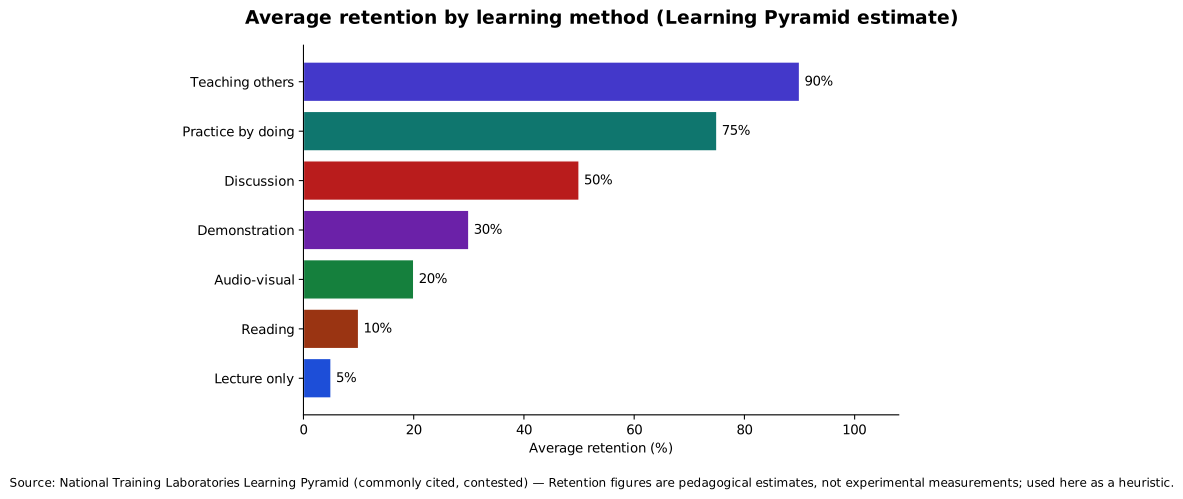
Learning retention varies sharply by method: passive review leaves the least memory, while teaching others produces the strongest, most durable understanding. Data adapted from the widely cited “learning pyramid” literature on retention rates by instructional method; exact percentages vary by study and should be read as illustrative.
The answer trap is especially tempting in exam cultures where the final output matters more than the process. A student in India preparing for board exams or entrance tests may see AI as a faster way to finish assignments. The danger is that finishing assignments and mastering material are not the same thing. The first is visible; the second is what lasts.
The Socratic Tutor
AI is at its best when it refuses to give the answer too quickly. Khanmigo, Khan Academy’s AI tutor, is designed to ask follow-up questions, suggest strategies, and keep the student doing the cognitive work. Duolingo Max uses similar conversational nudging for language practice. The model is old: the best human tutors do not lecture; they draw understanding out.
The student version of this habit is simple. Instead of asking “Explain photosynthesis,” ask “Ask me questions about photosynthesis until I can explain it correctly.” Instead of “Write my essay,” say “I want to argue that climate policy in India should prioritize solar; ask me tough questions about my reasoning.” The AI becomes a sparring partner, not a replacement.
Point C3 AI can lower the friction of producing explanations, flashcards, and practice questions. A student can turn a textbook chapter into a set of flashcards, generate wrong answers to critique, or ask for analogies in cricket, cooking, or Bollywood to make an abstract idea stick. The tool handles the busywork; the student still has to do the sense-making.
Learn in Public, Teach in Private
One of the most useful habits a student can build is public note-taking. After reading a chapter or finishing a problem set, write a short note explaining what you learned in language a classmate would understand. Post it on a blog, a study group chat, or even a personal notes page. The public part creates accountability. The private part is the real work: before you publish, you have to make the idea clear to yourself.
Peer teaching works the same way. A student who explains a concept to a friend learns it more deeply than one who only re-reads the textbook. AI can help prepare for that conversation—by generating practice questions, checking your explanations, or playing the role of a confused peer—but it cannot replace the moment when a real peer says, “I still don’t get it,” and you have to find another way in.
Point C4 The risk is that AI becomes a substitute for struggle; the opportunity is that it becomes a scaffold for struggle. Struggle is not a bug in learning. It is the mechanism. AI’s real promise is to make the right kind of struggle more bearable: giving hints instead of answers, examples instead of templates, feedback instead of grades.
A Few Rules of Thumb
If you are a student using AI, consider these guardrails:
- Never paste and submit. If the final output came from AI, your job is to rewrite it in your own words, argue with it, and make it yours.
- Ask for process, not product. Request hints, questions, analogies, and critiques rather than finished answers.
- Explain before you ask. Try to solve the problem or outline the argument yourself first. Use AI to spot gaps, not to fill them from zero.
- Publish what you learn. A weekly public note, even a short one, turns consumption into production and memory into understanding.
- Keep the struggle. If an AI response removes all difficulty, you have probably asked the wrong question.
These rules are not about being a purist. They are about protecting the attention you still have. A student who uses AI well finishes assignments faster and learns more deeply. A student who uses AI poorly finishes assignments faster and learns less. The difference is small in one evening and enormous over four years.
Sources and Method
This article draws on research about active learning and deliberate practice, product documentation from AI tutoring systems, and practical teaching literature. The guidance is framed as rules of thumb, not proven prescriptions, because the long-term effects of AI-assisted learning are still being studied. The underlying principle—active generation beats passive consumption—is well supported; the exact workflow will vary by subject, student, and tool.
Related in This Series
- The Worker’s Garden: Commutes, Side Projects, and Career Capital — similar strategies for working adults reclaiming small windows of time.
- The Family’s Garden: Attention Contracts at Home — how households can protect attention and model productive device use.
- Failure, Teaching, and the Skill Stack — why early bad work and public teaching are features of building substance.
- Attention, Substance, and the AI Moment — the full series guide and reading paths.
Article guideImportant points and sources4 pointsShow guideHide guide
- C001core · high · verifiedPassive consumption of AI-generated answers produces weaker learning than active explanation and problem-solving.
- C002core · high · verifiedTeaching what you learn—through notes, blogs, videos, or peer sessions—is one of the most reliable ways to deepen understanding.
- C003core · medium-high · verifiedAI can lower the friction of producing explanations, flashcards, and practice questions.
- C004argument · medium · verifiedThe risk is that AI becomes a substitute for struggle; the opportunity is that it becomes a scaffold for struggle.
SourcesSources used4 sourcesShow sourcesHide sources
Look closer
Sources and notes
Open detailsClose details
Look closer
Sources and notes
These notes collect the sources, counterpoints, and review status behind the article's important points. Read the essay first; open this when you want to check something.
Confidence reflects how strongly the sources support the point (low / medium / high). Status describes the point's role (e.g., core, argument, landscape). Sources link to supporting material;counterpoints note boundary conditions or conflicting findings.
Passive consumption of AI-generated answers produces weaker learning than active explanation and problem-solving.
verifiedreviewed 2026-07-18
- Sources (2)
“A 2014 meta-analysis in PNAS found that active learning significantly increases student performance in science, engineering, and mathematics compared with traditional lecturing.”
Freeman et al.: Active learning increases student performance in science, engineering, and mathematicsdirect“Deliberate practice research emphasizes active, effortful engagement with feedback as the driver of expertise development.”
Ericsson: The Role of Deliberate Practice in the Acquisition of Expert Performanceindirect
- Counterpoints (1)
AI-generated answers can be a starting point for novices who lack background knowledge; the harm depends on how the output is used, not on the tool itself.
Teaching what you learn—through notes, blogs, videos, or peer sessions—is one of the most reliable ways to deepen understanding.
verifiedreviewed 2026-07-18
- Sources (2)
“Active-learning methods that require students to explain, discuss, and apply concepts show larger learning gains than passive review.”
Freeman et al.: Active learning increases student performance in science, engineering, and mathematicsindirect“Explaining and receiving feedback are core components of deliberate practice that build robust mental representations.”
Ericsson: The Role of Deliberate Practice in the Acquisition of Expert Performanceindirect
- Counterpoints (1)
The benefit of teaching depends on preparation and prior understanding; explaining prematurely can reinforce misconceptions.
AI can lower the friction of producing explanations, flashcards, and practice questions.
verifiedreviewed 2026-07-18
- Sources (2)
“Khanmigo is designed as a Socratic tutor that asks questions rather than giving direct answers, scaffolding student thinking.”
Khan Academy: Khanmigodirect“Duolingo Max uses conversational AI to provide explanations and practice prompts tailored to learner mistakes.”
Duolingo: Duolingo Maxdirect
- Counterpoints (1)
Lower friction can also encourage shallow use; generating flashcards is only useful if the student actually studies them actively.
The risk is that AI becomes a substitute for struggle; the opportunity is that it becomes a scaffold for struggle.
verifiedreviewed 2026-07-18
- Sources (2)
“Deliberate practice requires working at the edge of current ability; removing all struggle eliminates the conditions for growth.”
Ericsson: The Role of Deliberate Practice in the Acquisition of Expert Performanceindirect“Tutoring systems that give hints rather than answers are intended to preserve productive struggle while reducing frustration.”
Khan Academy: Khanmigoindirect
- Counterpoints (1)
The boundary between scaffold and substitute is subjective and depends on student maturity, subject difficulty, and tool design; what scaffolds one learner may shortcut another.
Review recordHow this was madeShow detailsHide details
Created 2026-07-05 by human. Policy: policy:default v1.0.0.
✓ Approved hash matches current article
Reviews
- humanapproved2026-07-05
Scope: thesis, claims, tone, privacy, sources
contentHash:
73fada8fa9f0b4eb…Human author approved publication.
- humanapproved2026-07-18
Scope: article
contentHash:
33c249c6c530a333…Re-approved by maintainer after the meta#61 P2 series migration (hardcoded kicker strip + arc reorder; no prose change beyond the kicker line; issue #124 instruction).
Machine-readable files
The same points, sources, and relationships are also available as structured files for agents and tools. The JSON follows thepublication record schema.