In the 1960s, India faced a food crisis. Drought, population growth, and stagnant yields made famine a real possibility. The Green Revolution arrived as a technological package: high-yielding wheat and rice varieties, irrigation expansion, chemical fertilizers, and pesticides. Production soared. Imports fell. The threat of mass hunger receded. The immediate problem was solved.
But the package came with a deferred invoice. Groundwater levels fell in intensively farmed regions. Soils accumulated salts and lost organic matter. Crop diversity narrowed as farmers shifted toward a few high-yield cereals. These costs did not show up in the first harvest, or even the first decade. They accumulated slowly, across millions of fields, and were harder to see, harder to measure, and harder to reverse than the original hunger crisis had been.
Point C1 The Green Revolution dramatically increased cereal production and averted famine in India.
The Hunger Crisis and the Technological Fix
The scale of the achievement is hard to dispute. Between the mid-1960s and the early 2000s, India’s wheat and rice production more than doubled. The country moved from dependence on food imports to near self-sufficiency in cereals. That shift mattered for nutrition, price stability, and political sovereignty.
Economists Robert Evenson and Douglas Gollin, in a widely cited assessment, argue that the Green Revolution’s high-yielding varieties raised yields across much of Asia and Latin America and prevented significant food-shortfall losses. In India, the new seeds spread fastest in regions with reliable irrigation and supportive policy: Punjab, Haryana, and western Uttar Pradesh for wheat; the northwest and parts of the south for rice. The result was a concentrated productivity boom.
The success was real. It is also why the trade-off is so instructive. When a technology solves an urgent, visible problem, the later, diffuse costs struggle for attention.
Point C2 It also led to groundwater depletion, soil salinity, and reduced crop diversity in several regions.
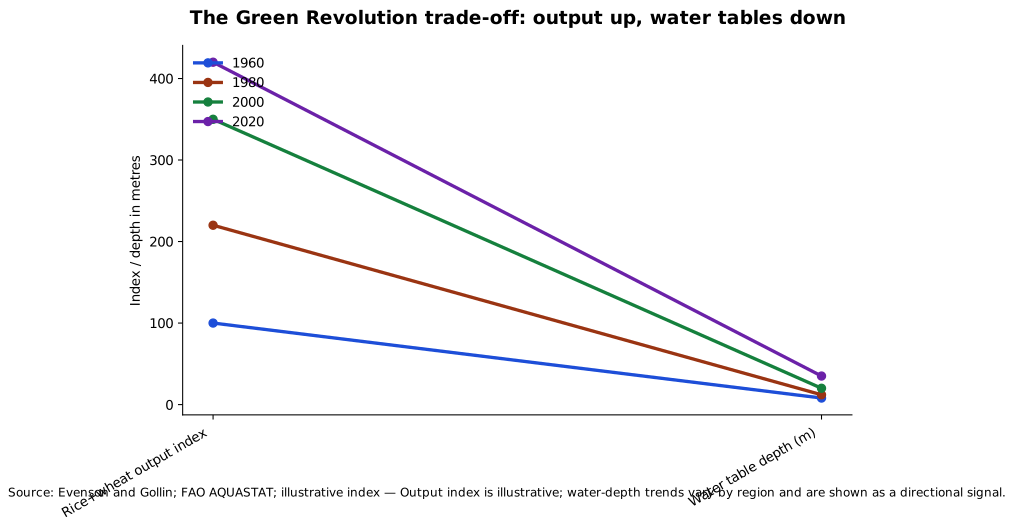
Green Revolution cereal output rose sharply while intensive irrigation drew down groundwater tables in India’s grain belt, illustrating the central trade-off. Sources: Evenson and Gollin; FAO AQUASTAT.
The Deferred Costs
The same irrigation that made high yields possible also drew down aquifers. The FAO’s water-resource assessments note that intensive groundwater pumping for agriculture has placed severe pressure on renewable water resources in parts of South Asia, including India’s grain belt. In Punjab and Haryana, groundwater extraction has long exceeded recharge rates. Soil salinity and waterlogging followed in some canal-irrigated areas.
Meanwhile, the shift toward wheat and rice displaced millets, pulses, and oilseeds in many cropping systems. Diets became more calorie-secure but less diverse. The ecological and nutritional costs were distributed across millions of farms and households, making them politically quieter than the famine threat had been.
Point C3 The costs were delayed and diffuse, making them politically harder to address than the initial hunger crisis.
The Access-Use Parallel
India’s digital story has followed a similar arc in one respect: an access crisis was solved with remarkable speed. Cheap smartphones and cheaper data brought hundreds of millions of people online. By 2024, India had roughly 886 million internet users, according to the IAMAI-Kantar Internet in India Report, and rural India was driving much of the growth. The access problem that policymakers had worried about for decades was largely resolved.
What came next was a use question. The same infrastructure that connected villages to government services, markets, and educational content also delivered infinite feeds, algorithmic recommendations, and gamified engagement designed to maximize time on platform. The NCAER India Human Development Survey Wave 3 found that roughly two-thirds of reported internet use is for entertainment while about one-sixth is for education. ASER 2024 reports that 76% of 14–16-year-olds use smartphones for social media while 57% use them for education.
These are not crises in the same sense as hunger. But they are slow, structural, and diffuse. Attention fragmentation, sleep disruption, reduced reading depth, and weakened civic discourse accumulate across millions of users. They do not produce a single headline in the way a famine does. They are easy to dismiss as individual choices or as the price of progress.
Point C4 Universal digital access similarly solves an access crisis while creating attention, mental-health, and civic-cohesion costs that accumulate slowly.
What the Analogy Does and Does Not Claim
The parallel is not exact. Food is a physical necessity; digital attention is not. The Green Revolution was a deliberate government-led agricultural policy; today’s attention economy is driven by private platforms and market incentives. The harms of the Green Revolution are ecological and nutritional; the harms of attention extraction are cognitive, psychological, and social.
What the analogy does offer is a pattern: societies tend to under-audit the long-term costs of technologies that solve an immediate, visible problem. The urgency of now wins over the accounting of later. The Green Revolution taught India that a technological package can be both a triumph and a source of deferred debt. The digital-access boom deserves the same long-term audit.
That audit does not mean rejecting technology. It means asking harder questions about design, defaults, and distribution. Who benefits when attention is the crop being harvested? What is being displaced? And what would it look like to optimize for long-term human capability rather than short-term engagement?
Sources and Method
This article draws on academic assessments of the Green Revolution (Evenson and Gollin), water-resource data (FAO AQUASTAT), and Indian digital-access and use surveys (IAMAI-Kantar Internet in India Report 2024, NCAER India Human Development Survey Wave 3, ASER 2024). The Green Revolution-to-digital analogy is interpretive, not causal; it is offered as a structural pattern rather than a claim that the two cases are identical.
Related in This Series
- Tobacco, Seatbelts, and Food Safety: How Societies Learn to Regulate Design — another historical frame on how societies move from “personal choice” to “design accountability.”
- The Jio Effect: Cheap Data and the Access-Behavior Paradox — the access story that sets up the use question.
- By the Numbers: What Indians Actually Do Online — the data picture behind the digital side of the analogy.
- Attention, Substance, and the AI Moment — the full series guide and reading paths.
Article guideImportant points and sources4 pointsShow guideHide guide
- C001core · high · verifiedThe Green Revolution dramatically increased cereal production and averted famine in India.
- C002core · high · verifiedThe Green Revolution also led to groundwater depletion, soil salinity, and reduced crop diversity in several regions.
- C003argument · medium-high · verifiedThe costs were delayed and diffuse, making them politically harder to address than the initial hunger crisis.
- C004argument · medium · verifiedUniversal digital access similarly solves an access crisis while creating attention, mental-health, and civic-cohesion costs that accumulate slowly.
SourcesSources used4 sourcesShow sourcesHide sources
- Evenson and Gollin: Assessing the Impact of the Green Revolutionpaper
- FAO: Water withdrawal and pressure on renewable water resourcesgovernment-report
- IAMAI-Kantar: Internet in India Report 2024industry-report
- ASER 2024 National Findingsresearch-report
Look closer
Sources and notes
Open detailsClose details
Look closer
Sources and notes
These notes collect the sources, counterpoints, and review status behind the article's important points. Read the essay first; open this when you want to check something.
Confidence reflects how strongly the sources support the point (low / medium / high). Status describes the point's role (e.g., core, argument, landscape). Sources link to supporting material;counterpoints note boundary conditions or conflicting findings.
The Green Revolution dramatically increased cereal production and averted famine in India.
verifiedreviewed 2026-07-18
- Sources (1)
“Evenson and Gollin assess that high-yielding varieties raised cereal yields across much of Asia and Latin America and prevented significant food-shortfall losses.”
Evenson and Gollin: Assessing the Impact of the Green Revolutiondirect
- Counterpoints (1)
The benefits were unevenly distributed by region, crop, and farm size; some areas and crops saw limited gains.
The Green Revolution also led to groundwater depletion, soil salinity, and reduced crop diversity in several regions.
verifiedreviewed 2026-07-18
- Sources (2)
“FAO water-resource assessments note that intensive groundwater pumping for agriculture has placed severe pressure on renewable water resources in parts of South Asia, including India's grain belt.”
FAO: Water withdrawal and pressure on renewable water resourcesdirect“The concentration on high-yielding wheat and rice displaced other crops in many cropping systems, contributing to reduced crop diversity.”
Evenson and Gollin: Assessing the Impact of the Green Revolutionindirect
- Counterpoints (1)
The severity of ecological impacts varied widely by irrigation management, soil type, and local policy; not all Green Revolution regions experienced the same costs.
The costs were delayed and diffuse, making them politically harder to address than the initial hunger crisis.
verifiedreviewed 2026-07-18
- Sources (2)
“Groundwater depletion and soil degradation accumulated over decades across millions of farms, lacking the single visible trigger of a famine.”
FAO: Water withdrawal and pressure on renewable water resourcesindirect“The Green Revolution's benefits were immediate and concentrated, while many of its costs emerged slowly and were spread across ecosystems and future harvests.”
Evenson and Gollin: Assessing the Impact of the Green Revolutionindirect
- Counterpoints (1)
Some policy responses, such as groundwater regulation and crop-diversification programs, did eventually emerge, showing the costs were not entirely ignored.
Universal digital access similarly solves an access crisis while creating attention, mental-health, and civic-cohesion costs that accumulate slowly.
verifiedreviewed 2026-07-18
- Sources (2)
“The Internet in India Report 2024 documents near-ubiquitous digital access and a usage mix dominated by entertainment and social media.”
IAMAI-Kantar: Internet in India Report 2024direct“ASER 2024 finds that 76% of 14–16-year-olds use smartphones for social media while 57% use them for education.”
ASER 2024 National Findingsindirect
- Counterpoints (1)
The analogy is interpretive, not causal; digital access also enables education, livelihoods, and civic participation, and the mental-health and civic-cohesion links remain contested.
Review recordHow this was madeShow detailsHide details
Created 2026-07-05 by human. Policy: policy:default v1.0.0.
✓ Approved hash matches current article
Reviews
- humanapproved2026-07-05
Scope: thesis, claims, tone, privacy, sources
contentHash:
1c2ebd611bacda78…Human author approved publication.
- humanapproved2026-07-18
Scope: article
contentHash:
d78941e6eda157f3…Re-approved by maintainer after the meta#61 P2 series migration (hardcoded kicker strip + arc reorder; no prose change beyond the kicker line; issue #124 instruction).
Machine-readable files
The same points, sources, and relationships are also available as structured files for agents and tools. The JSON follows thepublication record schema.