You are reading this on the most powerful device you have ever owned. It has more computing power than the machines that sent humans to the moon. It can translate between twenty-two Indian languages in real time. It can help you write, code, design, research, and teach — if you let it.
But that is not what it is mostly used for.
If you have traveled on a train in India recently — any train, any class — you already know this. Every face is lit by the same glow. Reels, web series, cricket highlights, political shouting matches, endless swiping. Headphones on, world off. It is not one demographic. It cuts across income, age, language, and region. The teenager scrolling reels, the mid-career professional bingeing a web series on a laptop, the retiree forwarding unverified health advice — different screens, same pattern. The only constant is the device, and the silence where conversation used to be.
This is not a lecture about discipline. It is a simple observation: you are carrying a power tool and using it as a toy. The toy is fun. The power tool could change your life.
Point C1 India has near-universal digital access, but entertainment and social media dominate online time across all age groups, crowding out education, planning, and productive use.
What the Numbers Say
India is set to cross 900 million internet users. Data is cheap enough to be an afterthought. Access is no longer the problem. The question is what people do with the access they have.
The answer is mostly entertainment. The NCAER India Human Development Survey Wave 3 found that roughly two-thirds of reported internet use is for entertainment, while only about one-sixth is for education — a ratio of about 4:1. ASER 2024 found that among 14–16-year-olds, 76% use smartphones for social media, while 57% use them for education. But this is not only a youth problem. The NSSO Time Use Survey 2024 found that 93% of Indians aged 6 and above participate in mass media or leisure activities, and leisure time has risen about 15% since 2019 — across every age bracket, not just the young.
Studies of Indian adolescents report 4–5 hours of daily screen time. In one rural study, 83% of secondary school children exceeded the recommended two-hour daily limit. But adults are not exempt: the working professional who opens Netflix on a laptop after dinner, the parent who scrolls for an hour in bed, the manager who checks WhatsApp between meetings instead of taking a real break — the pattern holds. The device changes, the screen size changes, the ratio does not.
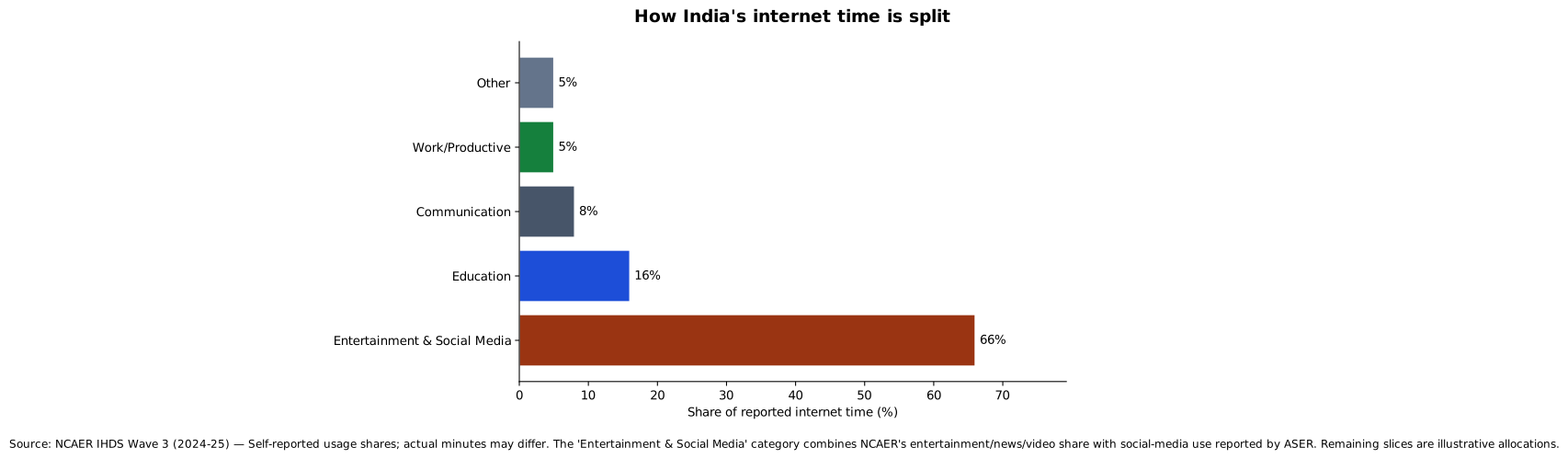
These are not isolated data points. They describe a structural pattern: a population with unprecedented access to information and shrinking capacity to use it for anything that requires sustained attention.
Point C2 Screen time is high across all age groups, and feeds — on phones and laptops — are engineered to extend engagement beyond user intent.
Why It Feels Like Rest (But Isn't)
Here is the uncomfortable part: it does not feel like a problem. A few reels after lunch, a web series before sleep, one more episode on the laptop, one more clip while waiting for a bus — these look like rest. They do not feel like extraction.
But rest is not what the design is optimizing for. Variable rewards keep you pulling because the next video might be great. Infinite scroll removes the natural stopping point. Autoplay carries you from one episode to the next without asking. Personalized recommendations reorder the world so everything feels relevant — whether you are on a 6-inch phone or a 15-inch laptop.
A peer-reviewed study on short-form video addiction found heavy use associated with impaired attention and reduced self-control. Gloria Mark’s research on attention spans found that the average time people spend on a screen before switching has fallen to roughly 47 seconds. Every switch carries a cognitive cost — the work of remembering what you were doing, reassembling context, getting back to where you were.
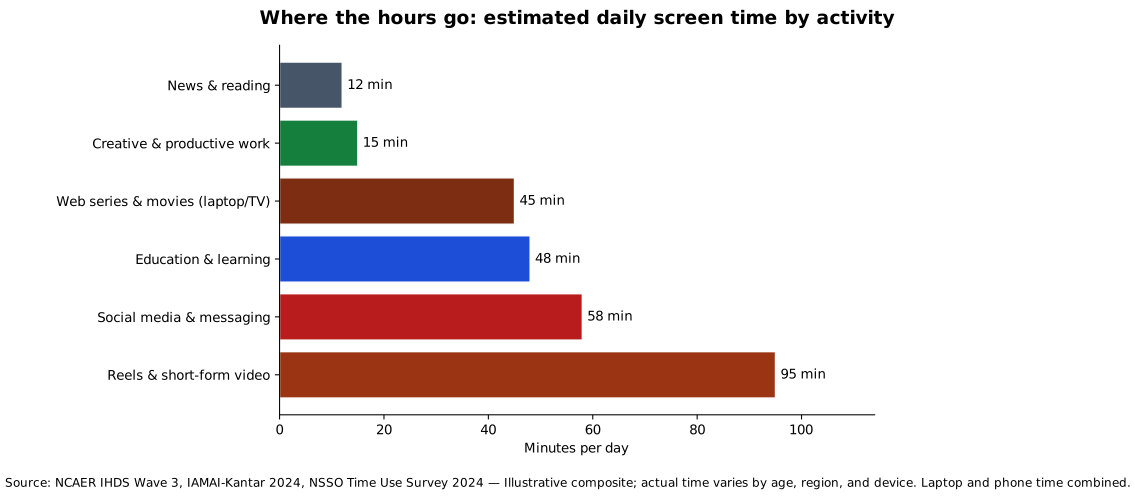
The result: you finish a one-hour scroll or binge session tired, not rested. Your attention is more fragmented than when you started. You did not learn anything you can recall the next morning. And the platform collected another hour of your life.
Point C3 The costs show up in productivity, mental health, and attention capacity — for everyone, not just students.
What It Costs You
The cost is personal before it is national. Gallup’s State of the Global Workplace data puts India’s employee engagement at 23% and estimates roughly $351 billion in annual losses from disengagement. Attention fragmentation is not the only cause, but it is one of them: the worker who checks feeds during commutes and meetings, then stays late to finish tasks, is paying a tax they cannot see.
The NCERT Mental Health and Well-being Survey of School Students reports significant levels of stress, anxiety, and screen-related concern. A peer-reviewed study reinforced the link between heavy social media use and psychological distress among Indian adolescents. Tele-MANAS, India’s national mental-health helpline, has documented rising call volumes — a signal that distress is being reported at scale, not hidden in private.
And there is a cost you cannot measure: the skill you did not build, the idea you did not explore, the conversation you did not have, the side project you never started. Time is zero-sum. An hour spent scrolling or bingeing is an hour not spent becoming slightly better at something — anything — that matters to you.
This Is Not Just for Young People
If you are in your thirties, forties, fifties, or beyond — this matters for you as much as anyone, maybe more.
You already have something most young people do not: experience. You understand problems because you have lived through them. You know which decisions matter and which ones are noise. You have professional networks, domain knowledge, and a sense of where things break in the real world.
What you may not have had until now is the time, the energy, or the bandwidth to act on that experience outside your day job. Family, commutes, deadlines, and financial responsibilities left little room for building something on the side. The friction of starting was too high.
That friction just collapsed. AI tools now let you draft a plan, prototype an idea, research a market, write a proposal, translate a document, or build a teaching module in the time it takes to watch one episode of a web series. You do not need to quit your job. You do not need funding. You do not need a team. You need fifteen minutes and the willingness to try.
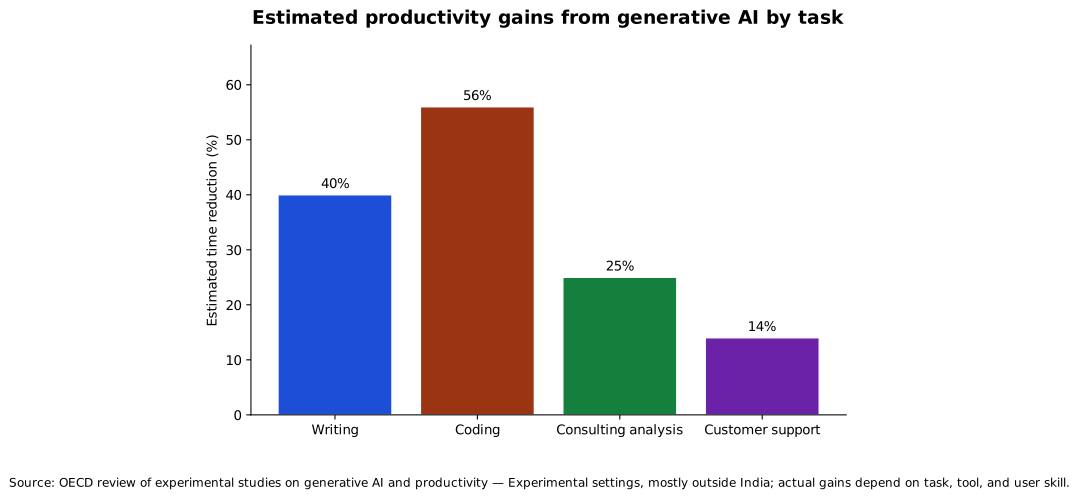
The person who has spent twenty years understanding logistics, healthcare, agriculture, education, finance, or manufacturing now has a tool that can turn that understanding into something shareable — an essay, a tool, a course, a framework — without requiring a sabbatical. The barrier between your experience and productive output has never been lower. The only question is whether you pick up the tool or pick up the remote.
Point C4 AI makes productive work dramatically cheaper and more accessible for everyone — but only for people who choose to use it that way.
The Head-to-Head
The easiest way to see the shift is to put the two options side by side. Same fifteen minutes. Same device. Different outcome.
| Instead of… | Try… | After one week |
|---|---|---|
| 15 min of cricket highlights | 15 min reading about a sector you want to understand | You know one industry better than most people in your circle |
| 15 min of reels | 15 min asking an AI to explain a concept you’ve always been curious about | You can hold a real conversation on that topic |
| 15 min of a web series on your laptop | 15 min drafting a rough plan for something you’ve wanted to build | You have the skeleton of a real project |
| 15 min scrolling random health advice | 15 min asking an AI targeted questions about your specific health or nutrition goals | You have a personalized plan instead of generic noise |
| 15 min of political outrage threads | 15 min researching a financial decision — a fund, a stock, a savings instrument | You made one informed decision instead of one angry comment |
| 15 min of aimless YouTube | 15 min learning to organize your own information — bookmarks, notes, a reading list | You built a system that serves you instead of a feed that farms you |
| 15 min of celebrity gossip | 15 min improving a skill relevant to your career — a tool, a framework, a language | You are slightly more valuable at work than last week |
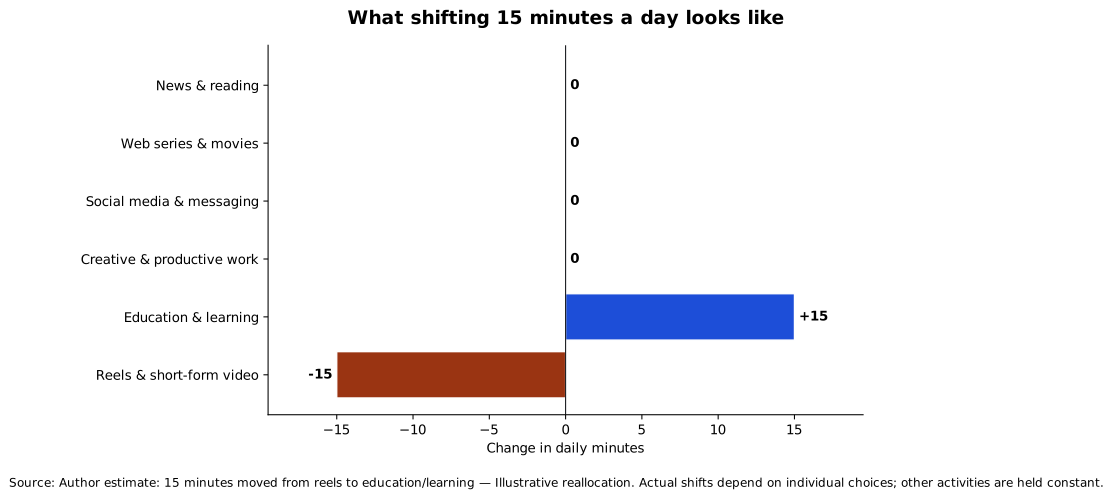
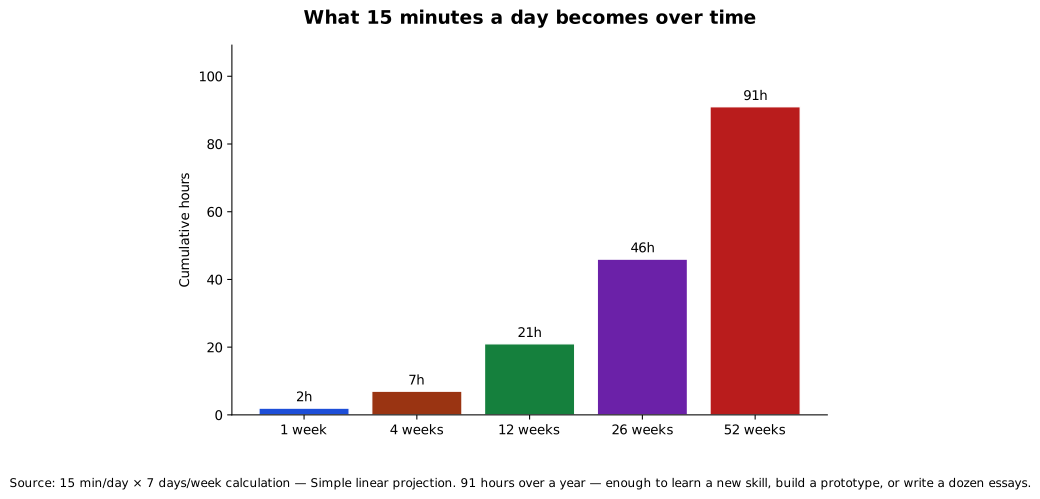
The point is not that entertainment is bad. The point is that the same fifteen minutes, redirected, compounds. Fifteen minutes a day is 91 hours a year. That is enough to learn the fundamentals of a new field, build a working prototype, write a dozen short essays, or make a dozen informed financial decisions. The cost of the scroll is not the fifteen minutes. It is what those fifteen minutes could have become.
Take Control Instead of Letting the Internet Decide
One of the biggest hidden costs of passive scrolling is that it trains you to be a consumer of whatever the algorithm decides to show you. Your feed decides what you eat, what you buy, what you believe, what you fear, and what you find funny. That is not discovery. That is being managed.
The alternative is to tell the internet what you want — not the other way around.
Want better food options? Instead of scrolling random food videos, ask an AI to help you plan meals based on your dietary needs, your budget, and what is available near you. Want better skincare? Instead of trusting influencer promotions, ask targeted questions about your skin type, cross-reference the answers, and build your own understanding. Want to plan your finances? Instead of watching random “money tips” reels, use AI to build a basic financial plan based on your income, your goals, and your risk tolerance.
The skill that matters now is not finding information. The internet has more than enough. The skill that matters is organizing information — deciding what you need, asking for it clearly, evaluating what comes back, and turning it into action. That is a skill anyone can build, at any age, with any device.
Learn to organize your own reading lists, your own research, your own notes. Learn to ask better questions. Learn to have opinions based on evidence you gathered yourself, not reactions manufactured for you. The difference between a person who scrolls and a person who searches is not intelligence. It is intention.
Point C5 Small, repeated shifts from consumption to creation can compound into real capability, and the main cost is attention reclaimed from low-value scrolling or bingeing.
What You Can Do Starting Today
This is not about quitting the internet. Entertainment has its place — on your phone, your laptop, or your TV. The goal is to shift the ratio, even slightly, so your screens start making you more capable instead of less.
Use the dead time. Fifteen minutes on a train, in a waiting room, between meetings, or before sleep. That is enough to learn something, draft something, or plan something. Over a year, it adds up to 91 hours.
Build one small thing. A chart, a blog post, a translated recipe, a financial plan, a two-minute voice note explaining what you learned today. It does not need to be good. It needs to exist. Skill is built through repetition with feedback, not through perfection on the first try.
Teach someone. Explaining an idea to a colleague, a child, or a friend is the fastest way to find out whether you actually understand it. Teaching turns passive information into owned knowledge.
Take charge of your discoverability. Stop letting the feed decide what you see. Build your own reading list. Ask your own questions. Form your own opinions. The internet is a library, not a remote control.
Ask the better question. The next time you unlock your phone or open your laptop, ask: “Is this screen making me more capable than it found me?” If the answer is no, you do not need to feel guilty. You need to try something different for fifteen minutes.
The research on habits is clear: make the first step small enough that friction disappears. You do not need a new schedule, a new app, or a digital-detox retreat. You need to redirect one small window of attention — today, then tomorrow, then the day after. That compounding is how capability is built.
Your Attention Is Your Vote
Here is the part most people miss: platforms build what audiences reward. Every reel watched, every episode auto-played, every outrage thread amplified, every hour spent scrolling is a signal. The algorithm is not a weather system; it is a mirror. It shows more of what people consume more of.
If millions of people start demanding substance — educational explainers, local-language tutorials, deep-dive interviews, small-creator work, practical tools — the feed will learn to surface it. That is not wishful thinking. It is how every advertising-supported platform in history has worked. The content you consume is the content you are asking for more of.
This means the lever is in your hand. Not next quarter, not after a policy change, not when a better platform arrives. Right now. Change what you demand from the device you are already holding — whether it is a phone in your pocket or a laptop on your desk. The platform will notice before the policymaker does.
You do not need to use your screens less. You need to use them better. The most powerful tool you own is waiting for you to decide what it is.
If you want deeper evidence, historical context, or discussion of design and policy alternatives, these articles expand on the themes above: The Attention Extraction, By the Numbers, What AI Makes Cheap, The Substance Builder, and AI as a Journeyman Assistant.
Article guideImportant points and sources5 pointsShow guideHide guide
- C001core · high · verifiedIndia has near-universal digital access, but entertainment and social media dominate online time across all age groups, crowding out education, planning, and productive use.
- C002core · high · verifiedScreen time is high across all age groups, and feeds — on phones and laptops — are engineered to extend engagement beyond user intent.
- C003core · medium-high · verifiedThe costs show up in productivity, mental health, and attention capacity — for everyone, not just students.
- C004core · medium-high · verifiedAI makes productive work dramatically cheaper and more accessible for everyone — but only for people who choose to use it that way.
- C005core · medium-high · verifiedSmall, repeated shifts from consumption to creation can compound into real capability, and the main cost is attention reclaimed from low-value scrolling or bingeing.
SourcesSources used20 sourcesShow sourcesHide sources
- IAMAI-Kantar: Internet in India Report 2024industry-report
- NCAER: The Evolving Landscape of Digital Inclusion in India (IHDS Wave 3)research-report
- ASER 2024 National Findingsresearch-report
- NSSO Time Use Survey 2024 Factsheetgovernment-report
- International Journal of Indian Psychology: Impact of Digital Screen Time on Adolescentspeer-reviewed-study
- PMC: Prevalence of excess screen time among secondary school children in rural Indiapeer-reviewed-study
- PMC: The adverse impact of mobile phone short-form video addiction on attentional functions and self-controlpeer-reviewed-study
- Steelcase: Our 47-Second Attention Span with Gloria Mark (transcript)interview-transcript
- Gallup State of the Global Workplace: India Country-Level Dataindustry-report
- PIB: NCERT Mental Health and Well-being Survey of School Studentsgovernment-press-release
- PMC: Social media and mental health among Indian adolescentspeer-reviewed-study
- PIB Tele-MANAS Press Notegovernment-press-release
- Milli et al.: Engagement, User Satisfaction, and the Amplification of Divisive Content on Social Media (PNAS Nexus)peer-reviewed-study
- Yale News: Likes and shares teach people to express more outrage onlineuniversity-news
- OECD: The effects of generative AI on productivity, innovation and entrepreneurshipresearch-report
- NASSCOM: AI Adoption Indexindustry-report
- PIB: 22 Languages, Digitally Reimagined — Bhashini under the National Language Translation Missiongovernment-press-release
- Cal Newport: Deep Workbook
- Anders Ericsson: The Role of Deliberate Practice in the Acquisition of Expert Performancepeer-reviewed-study
- BJ Fogg: Tiny Habitsbook-website
Look closer
Sources and notes
Open detailsClose details
Look closer
Sources and notes
These notes collect the sources, counterpoints, and review status behind the article's important points. Read the essay first; open this when you want to check something.
Confidence reflects how strongly the sources support the point (low / medium / high). Status describes the point's role (e.g., core, argument, landscape). Sources link to supporting material;counterpoints note boundary conditions or conflicting findings.
India has near-universal digital access, but entertainment and social media dominate online time across all age groups, crowding out education, planning, and productive use.
verifiedreviewed 2026-07-18
- Sources (3)
“The Internet in India Report 2024 documents near-ubiquitous access and a usage mix dominated by entertainment, social media, and messaging.”
IAMAI-Kantar: Internet in India Report 2024direct“Roughly two-thirds of reported internet use is for entertainment, while about one-sixth is for education—a ratio of about 4:1.”
NCAER: The Evolving Landscape of Digital Inclusion in India (IHDS Wave 3)direct“Among 14–16-year-olds, 76% use smartphones for social media while 57% use them for education.”
ASER 2024 National Findingsdirect
- Counterpoints (1)
The same platforms are used for peer learning, exam groups, and informal skill discovery, so the boundary between social and educational use is fuzzy.
Screen time is high across all age groups, and feeds — on phones and laptops — are engineered to extend engagement beyond user intent.
verifiedreviewed 2026-07-18
- Sources (5)
“93% of Indians aged 6 and above participate in mass media or leisure activities; leisure time has risen about 15% since 2019.”
NSSO Time Use Survey 2024 Factsheetdirect“A review of Indian adolescent screen-time studies reports averages of 4–5 hours per day across devices and activities.”
International Journal of Indian Psychology: Impact of Digital Screen Time on Adolescentsdirect“A rural Indian study found that 83.2% of secondary school children spent more than the recommended two hours per day on screen devices.”
PMC: Prevalence of excess screen time among secondary school children in rural Indiadirect“Heavy short-form video use is associated with impaired attention and reduced self-control.”
PMC: The adverse impact of mobile phone short-form video addiction on attentional functions and self-controldirect“Gloria Mark's research tracks the shrinking of attention spans, with the average screen switch occurring around 47 seconds.”
Steelcase: Our 47-Second Attention Span with Gloria Mark (transcript)indirect
- Counterpoints (1)
Users can disable autoplay, mute notifications, and set time limits; platform defaults are influential but not irresistible.
The costs show up in productivity, mental health, and attention capacity — for everyone, not just students.
verifiedreviewed 2026-07-18
- Sources (6)
“Gallup State of the Global Workplace 2025 places India's employee engagement at 23% and estimates $351 billion in annual losses from disengagement.”
Gallup State of the Global Workplace: India Country-Level Datadirect“The NCERT survey of school students reports significant stress, anxiety, and screen-related concern.”
PIB: NCERT Mental Health and Well-being Survey of School Studentsdirect“Social media use is linked to mental-health strain among Indian adolescents.”
PMC: Social media and mental health among Indian adolescentsdirect“Tele-MANAS call volumes indicate rising reported mental-health distress at scale.”
PIB Tele-MANAS Press Noteindirect“Engagement-based recommendation systems amplify divisive content on social media.”
Milli et al.: Engagement, User Satisfaction, and the Amplification of Divisive Content on Social Media (PNAS Nexus)direct“Likes and shares teach users to express more outrage online over time.”
Yale News: Likes and shares teach people to express more outrage onlinedirect
- Counterpoints (1)
Productivity and mental health are also shaped by wages, job quality, education, and family environment; the attention economy is one factor among many.
AI makes productive work dramatically cheaper and more accessible for everyone — but only for people who choose to use it that way.
verifiedreviewed 2026-07-18
- Sources (4)
“An OECD review found professionals using generative AI completed writing tasks roughly 40% faster with quality up about 18%, and developers using AI assistants coded 56% faster.”
OECD: The effects of generative AI on productivity, innovation and entrepreneurshipdirect“The NASSCOM AI Adoption Index estimates that four key sectors could contribute roughly 60% of India's potential AI-driven GDP value by FY2026, and that India's AI skills penetration is above the global average.”
NASSCOM: AI Adoption Indexdirect“Bhashini, under the National Language Translation Mission, is building real-time translation and speech-to-text across 22 scheduled Indian languages.”
PIB: 22 Languages, Digitally Reimagined — Bhashini under the National Language Translation Missiondirect“The 4:1 entertainment-to-education internet-use ratio shows the current direction of India's digital attention budget.”
NCAER: The Evolving Landscape of Digital Inclusion in India (IHDS Wave 3)indirect
- Counterpoints (1)
The link between AI-induced time savings and reinvestment is conceptual; no direct measurement shows how saved time is currently being used in India.
Small, repeated shifts from consumption to creation can compound into real capability, and the main cost is attention reclaimed from low-value scrolling or bingeing.
verifiedreviewed 2026-07-18
- Sources (4)
“Deep work frames long, uninterrupted, cognitively demanding effort as the source of rare and valuable capability.”
Cal Newport: Deep Workdirect“Ericsson's research on deliberate practice emphasizes repeated, focused effort with feedback as the driver of expertise acquisition.”
Anders Ericsson: The Role of Deliberate Practice in the Acquisition of Expert Performancedirect“Tiny Habits shows that making the first step small enough removes the friction that normally stops behavior change.”
BJ Fogg: Tiny Habitsdirect“Generative AI lowers the cost of producing first drafts, making it easier to start writing, coding, translating, and explaining.”
OECD: The effects of generative AI on productivity, innovation and entrepreneurshipindirect
- Counterpoints (1)
Some people face genuine structural constraints that leave little reclaimable attention regardless of intention.
Review recordHow this was madeShow detailsHide details
Created 2026-07-05 by human. Policy: policy:default v1.0.0.
✓ Approved hash matches current article
Reviews
- humanapproved2026-07-05
Scope: thesis, claims, tone, privacy
contentHash:
638f59058b3f8eab…Human author approved original publication as a TLDR summary of the series. Re-approved 2026-07-06 after sibling-agent review and chart fixes: pie-to-bar internet split, sorted daily-breakdown with semantic colors, diverging head-to-head 15-minute shift chart, SVG text-as-text, and accessible high-contrast palette.
Machine-readable files
The same points, sources, and relationships are also available as structured files for agents and tools. The JSON follows thepublication record schema.