The last few years have turned the cost of producing a draft, a line of code, a translation, or a voiceover upside down. Tasks that once required a trained professional, a studio, or a team can now be started with a prompt and finished with human judgment. The technology is not perfect, but it is already good enough to change the economics of knowledge work.
This article is not about whether generative AI is intelligent. It is about what it makes cheap, who gains first, and what India risks if the time it saves is captured by the same attention-extraction economy the series has been diagnosing.
The Cost of a Draft Is Falling
Point C1 Generative AI can now produce acceptable first drafts of text, code, translation, images, and voice at a small fraction of the previous cost and time.
An OECD review of experimental studies found that professionals using generative AI completed writing tasks roughly 40% faster, with quality scores rising about 18%. Developers using GitHub Copilot finished coding tasks 56% faster, with the biggest gains among less experienced programmers. Consultants in a controlled trial completed 12% more tasks, finished them 25% faster, and scored more than 40% higher on quality. Translators, legal researchers, and customer-support agents have shown similar patterns.
These are not marginal improvements. They are step changes in the cost of producing a first pass. The implication is broader than faster work: many tasks that once required years of training or expensive infrastructure can now be initiated by someone with a clear question and the ability to check the answer.
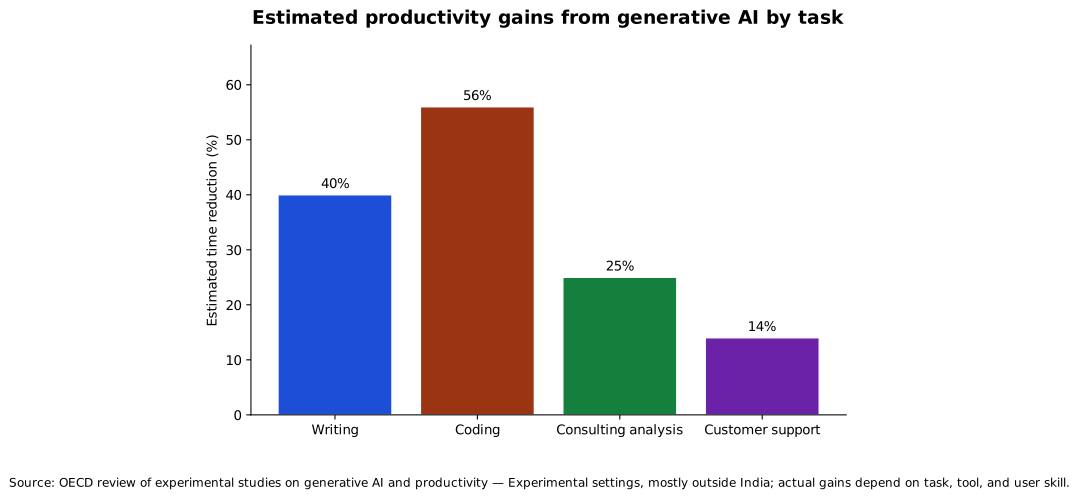
Source: OECD review of experimental studies on generative AI and productivity. Caveat: Experimental settings, mostly outside India; actual gains depend on task, tool, and user skill.
Who Benefits Most
Point C2 The largest productivity gains from generative AI show up for less experienced workers and in well-defined, bounded tasks, narrowing some skill gaps while raising the premium on judgment and verification.
The same OECD review notes that generative AI tends to help most when the task is clearly bounded and the user is less experienced. A junior coder, a new translator, or a first-time report writer can move faster because the tool supplies scaffolding. Experienced workers also gain, but mainly when they use AI to delegate routine parts and keep human judgment on the hard parts.
This creates two risks. One is over-reliance: accepting a plausible but wrong output can be worse than doing the work slowly. The other is a widening gap between people who learn to verify and people who only learn to prompt. The scarce resource is no longer the ability to draft; it is the ability to judge whether the draft is right.
India's Language Layer
Point C3 India’s Bhashini platform is an example of making multilingual AI a public good, offering translation and speech-to-text across 22 scheduled Indian languages.
Most global AI models are trained disproportionately on English and a few major languages. For a country where the majority of internet users prefer Indic languages, that is a structural bottleneck. Bhashini, launched under the National Language Translation Mission, provides AI-powered translation, automatic speech recognition, and text-to-speech across all 22 scheduled Indian languages.
The platform matters because language is a gatekeeper. Cheaper translation lowers the cost of education, government service, commerce, and local content creation for hundreds of millions of users. It is also an example of public infrastructure shaping who benefits from AI: if language models remain dominated by foreign platforms, the savings flow outward; if public tools like Bhashini scale, the savings can stay local.
The Enterprise Gap
Point C4 Indian enterprise adoption of generative AI remains early: a minority have production workloads or can fully measure AI returns, suggesting the cost savings are not yet system-wide.
An EY India survey of C-suite executives found that 36% of Indian enterprises had allocated budgets to generative AI and another 24% were testing it, but only 15% had generative AI workloads in production and only 8% could fully measure and allocate AI returns. The same report estimates that the AI platform shift could affect 38 million organized-sector employees and add about 2.61% to productivity by 2030, but only if adoption deepens beyond pilots.
Point C5 NASSCOM’s AI Adoption Index estimates that four sectors—BFSI, retail and CPG, healthcare, and industrials/automotive—could contribute roughly 60% of India’s potential AI-driven GDP value by FY2026, and that India’s AI skills penetration is above the global average.
The NASSCOM AI Adoption Index places India as an “Enthusiast” rather than an expert on the maturity curve, but notes that India’s AI skills penetration between 2015 and 2021 was more than three times the global average. The opportunity is real; the gap is between capability and deployment.
The Real Scarcity Is Attention and Judgment
Point C6 Because attention is the limiting input, the economic value of cheaper knowledge work depends on whether saved time is reinvested in learning, creation, and problem-solving or recaptured by extraction.
India already has one of the world’s largest digital populations and one of its cheapest data environments. The Economic Survey 2025–26 warned that digital addiction threatens the demographic dividend. Earlier articles in this series showed why: NCAER data puts India’s entertainment-to-education internet-use ratio at roughly 4:1, and ASER 2024 found that 76% of 14–16-year-olds use smartphones for social media while 57% use them for education.
AI does not automatically reverse this. A tool that writes code in half the time can free up an hour for deeper engineering or for more scrolling. A tutoring bot that explains a chapter in Hindi can help a student practice or keep her in an app longer. The technology makes the doing cheaper; it does not choose the direction.
That is why the dividend is not primarily a technology question. It is an allocation question. The scarce inputs are attention, intent, and the skill to judge quality. If those are captured by extraction, AI becomes a faster way to move through the same feed.
AI Could Cheapen Extraction Too
Point C7 Without deliberate redirection, AI could also make extraction cheaper—through hyper-personalized feeds, synthetic content, and automated influencers—lowering the cost of capturing attention.
The same capabilities that help a student draft an essay or a farmer check a scheme in his language can also generate personalized hooks, synthetic video, and algorithmic outrage at scale. The OECD review flags misuse, bias, and manipulated content as real risks alongside productivity gains. When the cost of producing content falls toward zero, the fight for attention becomes more intense, not less.
This is the compounding bet at the heart of the series. AI can make substance cheaper to create, but it can also make extraction cheaper to operate. The difference is not in the model; it is in the surrounding choices—individual habits, platform metrics, business models, and policy.
Sources and Method
This article draws on an OECD review of experimental studies on generative AI, productivity, innovation, and entrepreneurship; an EY India report on generative AI adoption and productivity; the NASSCOM AI Adoption Index; a PIB release on Bhashini; and earlier series sources including the Economic Survey 2025–26, NCAER India Human Development Survey Wave 3, and ASER 2024. Most productivity figures are from experimental studies, not representative Indian workforce data, and are presented as directional evidence rather than national estimates.
Open Questions
- Which Indian sectors are moving fastest from generative-AI pilots to measurable productivity gains?
- Can public tools like Bhashini stay competitive with well-funded global platforms as models improve?
- What share of time saved by AI in workplaces is currently being reinvested in higher-value work?
- How should schools and vocational programs teach judgment and verification when drafting becomes cheap?
- Could AI-assisted tutoring improve learning outcomes without increasing total screen time?
Related in This Series
- The Attention Extraction — the diagnosis of how India’s digital dividend became a cognitive deficit.
- By the Numbers: What Indians Actually Do Online — the usage mix that sets the stage for the AI opportunity cost.
- The Generational Bet — why the next few years are a compounding bet for India’s young population.
- The Substance Builder — practical ways to turn reclaimed time into small acts of creation.
- Designing for Substance — how platforms, metrics, and regulation could make substance the easier path.
- Attention, Substance, and the AI Moment — the series guide and reading paths.
Article guideImportant points and sources7 pointsShow guideHide guide
- C001core · high · verifiedGenerative AI can now produce acceptable first drafts of text, code, translation, images, and voice at a small fraction of the previous cost and time.
- C002core · high · verifiedThe largest productivity gains from generative AI show up for less experienced workers and in well-defined, bounded tasks, narrowing some skill gaps while raising the premium on judgment and verification.
- C003landscape · high · verifiedIndia's Bhashini platform is an example of making multilingual AI a public good, offering translation and speech-to-text across 22 scheduled Indian languages.
- C004landscape · medium-high · verifiedIndian enterprise adoption of generative AI remains early: a minority have production workloads or can fully measure AI returns, suggesting the cost savings are not yet system-wide.
- C005landscape · medium-high · verifiedNASSCOM's AI Adoption Index estimates that four sectors—BFSI, retail and CPG, healthcare, and industrials/automotive—could contribute roughly 60% of India's potential AI-driven GDP value by FY2026, and that India's AI skills penetration is above the global average.
- C006core · medium-high · verifiedBecause attention is the limiting input, the economic value of cheaper knowledge work depends on whether saved time is reinvested in learning, creation, and problem-solving or recaptured by extraction.
- C007core · medium · verifiedWithout deliberate redirection, AI could also make extraction cheaper—through hyper-personalized feeds, synthetic content, and automated influencers—lowering the cost of capturing attention.
SourcesSources used7 sourcesShow sourcesHide sources
- OECD: The effects of generative AI on productivity, innovation and entrepreneurshipresearch-report
- EY India: The AIdea of India 2025 — How much productivity can GenAI unlock in India?industry-report
- NASSCOM: AI Adoption Indexindustry-report
- PIB: 22 Languages, Digitally Reimagined — Bhashini under the National Language Translation Missiongovernment-press-release
- PIB: Economic Survey 2025-26 — Public Health, Digital Addiction and Mental Health (Release ID 2219931, 29 Jan 2026)government-press-release
- NCAER: The Evolving Landscape of Digital Inclusion in India (IHDS Wave 3)research-report
- ASER 2024 National Findingsresearch-report
Look closer
Sources and notes
Open detailsClose details
Look closer
Sources and notes
These notes collect the sources, counterpoints, and review status behind the article's important points. Read the essay first; open this when you want to check something.
Confidence reflects how strongly the sources support the point (low / medium / high). Status describes the point's role (e.g., core, argument, landscape). Sources link to supporting material;counterpoints note boundary conditions or conflicting findings.
Generative AI can now produce acceptable first drafts of text, code, translation, images, and voice at a small fraction of the previous cost and time.
verifiedreviewed 2026-07-18
- Sources (1)
“An OECD review found professionals using generative AI completed writing tasks ~40% faster with quality up ~18%, developers using Copilot coded 56% faster, and consultants completed 12% more tasks 25% faster.”
OECD: The effects of generative AI on productivity, innovation and entrepreneurshipdirect
- Counterpoints (1)
Outputs often require human verification; hallucinations and quality variation mean the first draft is not the final product.
The largest productivity gains from generative AI show up for less experienced workers and in well-defined, bounded tasks, narrowing some skill gaps while raising the premium on judgment and verification.
verifiedreviewed 2026-07-18
- Sources (1)
“The OECD review notes that generative AI tends to help most when tasks are clearly bounded and users are less experienced, while experienced workers gain mainly by delegating routine parts and retaining judgment on complex parts.”
OECD: The effects of generative AI on productivity, innovation and entrepreneurshipdirect
- Counterpoints (1)
Some experiments also show gains for experienced workers who integrate AI strategically; bounded-task gains may not transfer to open-ended, high-stakes work.
India's Bhashini platform is an example of making multilingual AI a public good, offering translation and speech-to-text across 22 scheduled Indian languages.
verifiedreviewed 2026-07-18
- Sources (1)
“Bhashini, under the National Language Translation Mission, is an AI platform enabling real-time translation, automatic speech recognition, and text-to-speech across 22 scheduled Indian languages.”
PIB: 22 Languages, Digitally Reimagined — Bhashini under the National Language Translation Missiondirect
- Counterpoints (1)
Coverage of 22 languages does not mean equal quality across all languages and dialects; performance depends on available training data.
Indian enterprise adoption of generative AI remains early: a minority have production workloads or can fully measure AI returns, suggesting the cost savings are not yet system-wide.
verifiedreviewed 2026-07-18
- Sources (1)
“EY India's C-suite survey found 36% of Indian enterprises had allocated budgets to generative AI and 24% were testing it, but only 15% had generative AI workloads in production and only 8% could fully measure and allocate AI returns.”
EY India: The AIdea of India 2025 — How much productivity can GenAI unlock in India?direct
- Counterpoints (1)
The survey is a snapshot of C-suite self-reporting; adoption numbers may have changed rapidly after the survey period.
NASSCOM's AI Adoption Index estimates that four sectors—BFSI, retail and CPG, healthcare, and industrials/automotive—could contribute roughly 60% of India's potential AI-driven GDP value by FY2026, and that India's AI skills penetration is above the global average.
verifiedreviewed 2026-07-18
- Sources (1)
“The NASSCOM AI Adoption Index estimates that four key sectors could contribute ~60% of the potential AI-driven value add to India's GDP by FY2026, and that India's AI skills penetration between 2015 and 2021 was 3.09 times the global average.”
NASSCOM: AI Adoption Indexdirect
- Counterpoints (1)
Potential value is not guaranteed value; skills penetration does not imply equal deployment or productivity realization across sectors.
Because attention is the limiting input, the economic value of cheaper knowledge work depends on whether saved time is reinvested in learning, creation, and problem-solving or recaptured by extraction.
verifiedreviewed 2026-07-18
- Sources (2)
“The Economic Survey 2025-26 warned that digital addiction threatens India's demographic dividend, framing attention as a scarce national resource.”
PIB: Economic Survey 2025-26 — Public Health, Digital Addiction and Mental Health (Release ID 2219931, 29 Jan 2026)indirect“NCAER IHDS Wave 3 reports a 4.1:1 entertainment-to-education internet-use ratio, showing the current direction of India's digital attention budget.”
NCAER: The Evolving Landscape of Digital Inclusion in India (IHDS Wave 3)indirect
- Counterpoints (1)
The link between AI-induced time savings and reinvestment is conceptual; no direct measurement shows how saved time is currently being used in India.
Without deliberate redirection, AI could also make extraction cheaper—through hyper-personalized feeds, synthetic content, and automated influencers—lowering the cost of capturing attention.
verifiedreviewed 2026-07-18
- Sources (1)
“The OECD review flags misuse, bias, manipulated content, and the risk of over-reliance alongside productivity gains, noting that lower content-production costs can scale both beneficial and harmful uses.”
OECD: The effects of generative AI on productivity, innovation and entrepreneurshipindirect
- Counterpoints (1)
The extraction risk is prospective; current Indian-scale measurement of AI-driven synthetic content or automated influencers is not cited here.
Review recordHow this was madeShow detailsHide details
Created 2026-07-05 by human. Policy: policy:default v1.0.0.
✓ Approved hash matches current article
Reviews
- humanapproved2026-07-05
Scope: thesis, claims, tone, privacy, sources
contentHash:
264b2f4d83d62522…Human author approved publication.
- humanapproved2026-07-17
Scope: article
contentHash:
fe2c2d3c4f380726…Re-approved by maintainer after the meta#61 P1 citation repairs (publish instruction, 2026-07-17).
- humanapproved2026-07-18
Scope: article
contentHash:
3752ac0c2405fa4b…Re-approved by maintainer after the meta#61 P2 series migration (hardcoded kicker strip + arc reorder; no prose change beyond the kicker line; issue #124 instruction).
Machine-readable files
The same points, sources, and relationships are also available as structured files for agents and tools. The JSON follows thepublication record schema.