India’s digital story is usually told as a universal access story: cheaper data, cheaper phones, more users. But access is not experienced uniformly. Gender shapes when people come online, what devices they control, how much uninterrupted time they have, and what risks they face for being visible.
The result is a double bind for women. Lower access and weaker digital skills limit participation; those who do participate often encounter heavier care burdens, higher safety costs, and narrower economic returns. The attention economy does not create this inequality from nothing, but it can amplify it.
Point C1 Women in India face a double bind in the attention economy: lower access and digital skills limit participation, while those who do participate encounter disproportionate care burdens, safety risks, and economic inequality.
The Access Gap
By 2024, India had roughly 886 million internet users, and women made up 47% of that base—the highest share on record, according to the IAMAI-Kantar Internet in India Report 2024. That is real progress. It still means that more than half of India’s internet users are men, in a country where women are nearly half the population.
The gap is sharper at the point of entry. The NSSO’s Comprehensive Annual Modular Survey (CAMS), 2022-23, analysed by Data For India, found that about 85% of Indian adults had used a mobile phone in the three months before the survey. But roughly eight in ten women had done so, compared with over nine in ten men. For internet use, the split was steeper: about two-thirds of men had used the internet recently, against roughly half of women. Point C2
GSMA’s Mobile Gender Gap Report 2024 adds a global frame: across low- and middle-income countries, women are about 15% less likely than men to use mobile internet, and roughly 60% of the unconnected women in those countries live in South Asia or Sub-Saharan Africa. Point C3 India is part of that concentration. An Ideas for India synthesis cites GSMA data showing that Indian women are 33% less likely than men to use mobile internet, and only around 30% know how to use the internet to find information, operate mobile money, or access apps and e-services.
Many women who do get online use shared devices. The IAMAI-Kantar report notes that 58% of rural shared-device users are women. Sharing shapes what a user can do, when they can do it, and how much privacy they have.
Time, Care, and the Attention Tax
Access is only part of the story. Time is the other.
The NSSO Time Use Survey 2024 found that women who performed unpaid domestic services spent 289 minutes a day on them, compared with 88 minutes for men. On caregiving, women spent 137 minutes versus men’s 75 minutes. Point C4 These burdens do not disappear when a phone enters the household. They shape when, where, and how a woman can use it.
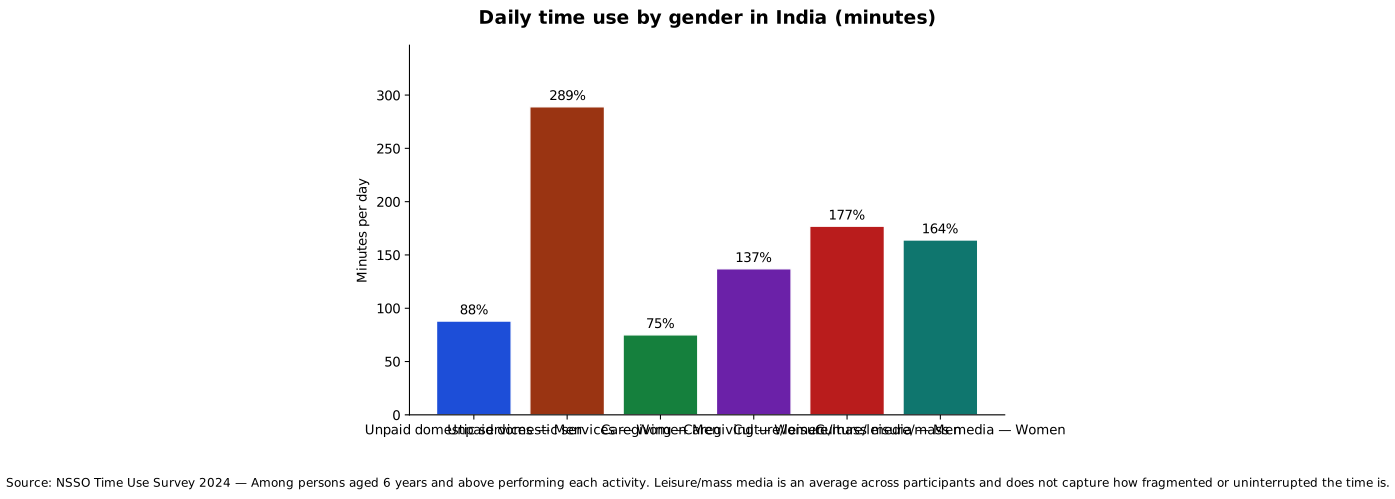
Source: NSSO Time Use Survey 2024; among persons aged 6 years and above performing each activity. Leisure/mass media is an average across participants and does not capture how fragmented or uninterrupted the time is.
The same survey records that men who engaged in culture, leisure, or mass-media activities spent 177 minutes a day on them; women spent 164 minutes. The gap in minutes looks modest, but the context matters. Women’s leisure is more likely to be fragmented and interleaved with care work; men’s is more likely to be uninterrupted. For women, the same device is often a source of entertainment, a family communication hub, a learning tool, and a childcare aid—sometimes at the same time. Point C5
This means the attention economy does not just extract time; it extracts a scarcer, more interrupted resource for women.
Safety and the Cost of Visibility
For women, being visible online carries gendered risks. A 2026 parliamentary committee report on cybercrimes against women, summarised by PRS Legislative Research, noted that cybercrimes against women in India rose 239% between 2017 and 2022. The forms are familiar: stalking, harassment, impersonation, doctored images, and extortion. Point C6
The risk is not evenly distributed. Women journalists, politicians, and activists report high rates of online abuse globally, and India sees the same pattern in public debate and police data. The effect is to raise the price of visibility. Some women self-censor, limit their time online, or avoid platforms where abuse is common. Others restrict the topics they discuss or the identities they reveal. The attention economy promises voice; for many women, it also demands a risk calculation.
The Creator Economy's Gender Skew
The creator economy is often held up as a leveler: anyone with a phone can publish. But the economics are not gender-neutral. India’s influencer marketing industry is estimated at over INR 5,500 crore, yet the distribution of opportunity is uneven. Women creators face pressure to perform visibility while also managing the safety and reputation risks that come with it.
Globally, women are well represented in influencer marketing, but earnings and platform power are concentrated. In India, only about 2.2% of employed women work in business services, according to research cited by Ideas for India, and the digital-skills gap is one reason why. Point C7 The attention economy rewards sustained, public, often entertainment-oriented presence. That model is harder to sustain for women who carry a disproportionate care load and who must weigh visibility against safety.
What Substance Would Look Like
A gender-blind attention policy will widen gaps. A substance-oriented design would start from the actual constraints: shared devices, interrupted time, safety concerns, and unequal digital skills.
That means offline-capable and low-bandwidth educational content, because many women learn in short windows. It means safe-reporting paths that do not require public confrontation. It means care infrastructure—childcare, eldercare, predictable work hours—that frees up the attention women are already being asked to give. And it means measuring success not just by total screen time, but by who gets to use that time for learning, earning, and civic voice.
The AI moment adds urgency. Artificial intelligence could reduce the friction of learning, job matching, and language translation in ways that particularly help women constrained by time, mobility, or language. But it could also widen gaps if the data, interfaces, and business models are built mainly by and for men with uninterrupted connectivity. Closing the gender gap in attention is not a side issue; it is a test of whether India’s digital dividend reaches everyone.
Sources and Method
This article draws on government surveys (NSSO Time Use Survey 2024, NSSO Comprehensive Annual Modular Survey 2022-23 via DataForIndia), industry reports (IAMAI-Kantar Internet in India Report 2024, GSMA Mobile Gender Gap Report 2024), parliamentary research (PRS Legislative Research summary of the Committee on the Empowerment of Women, 2026), and policy analysis (Ideas for India). Where figures are estimates or global benchmarks applied to India, the text says so.
Open Questions
- How much of the gender gap in internet use is due to device access, digital skills, care burdens, and social norms respectively?
- Do women and men in India use the same platforms for different purposes, and does platform design amplify or reduce the gap?
- What design features most reduce safety risks for women without becoming paternalistic?
- How can the creator economy distribute opportunity more evenly across gender?
- Would public investment in care infrastructure shift women’s digital time from consumption to production?
Related in This Series
- The Attention Extraction — the diagnosis of how attention is extracted.
- By the Numbers: What Indians Actually Do Online — the country’s digital time budget.
- The Generational Bet — why the AI moment makes attention choices urgent.
- The Substance Builder — practical paths for turning attention toward learning and creation.
- Designing for Substance — how platforms and metrics could reward substance.
- Attention, Substance, and the AI Moment — the series guide.
Article guideImportant points and sources7 pointsShow guideHide guide
- C001core · medium-high · verifiedWomen in India face a double bind in the attention economy: lower access and digital skills limit participation, while those who do participate encounter disproportionate care burdens, safety risks, and economic inequality.
- C002core · high · verifiedNSSO CAMS 2022-23 data show a sharp gender gap at the point of digital entry: roughly eight in ten women had recently used a mobile phone, compared with over nine in ten men, and roughly half of women had recently used the internet, compared with about two-thirds of men.
- C003landscape · medium-high · verifiedGSMA's Mobile Gender Gap Report 2024 shows that women in low- and middle-income countries are about 15% less likely than men to use mobile internet, with roughly 60% of unconnected women concentrated in South Asia and Sub-Saharan Africa; India-specific estimates show women are 33% less likely than men to use mobile internet.
- C004core · high · verifiedNSSO Time Use Survey 2024 found that women who performed unpaid domestic services spent 289 minutes a day on them, compared with 88 minutes for men, and women spent 137 minutes on caregiving versus men's 75 minutes.
- C005framing · medium · verifiedWomen's leisure and mass-media time is more fragmented by unpaid care work than men's, so the attention economy extracts a scarcer, more interrupted resource from women even when raw minutes look similar.
- C006landscape · high · verifiedA 2026 parliamentary committee report summarised by PRS Legislative Research noted that cybercrimes against women in India rose 239% between 2017 and 2022.
- C007landscape · medium · verifiedThe creator economy and high-skill digital work remain unevenly accessible to women: only about 2.2% of employed Indian women work in business services, partly due to the digital-skills gap.
SourcesSources used6 sourcesShow sourcesHide sources
- NSSO Time Use Survey 2024 Factsheetgovernment-report
- Data For India: Access to phones and the internet (based on NSSO CAMS 2022-23)research-report
- IAMAI-Kantar: Internet in India Report 2024industry-report
- GSMA: The Mobile Gender Gap Report 2024industry-report
- Ideas for India: Digital gender divide amidst India's service-led growthresearch-report
- PRS Legislative Research: Cyber Crimes and Cyber Security of Women (Committee on the Empowerment of Women, 2026)government-report
Look closer
Sources and notes
Open detailsClose details
Look closer
Sources and notes
These notes collect the sources, counterpoints, and review status behind the article's important points. Read the essay first; open this when you want to check something.
Confidence reflects how strongly the sources support the point (low / medium / high). Status describes the point's role (e.g., core, argument, landscape). Sources link to supporting material;counterpoints note boundary conditions or conflicting findings.
Women in India face a double bind in the attention economy: lower access and digital skills limit participation, while those who do participate encounter disproportionate care burdens, safety risks, and economic inequality.
verifiedreviewed 2026-07-18
- Sources (3)
“NSSO CAMS 2022-23 finds roughly eight in ten women had recently used a mobile phone versus over nine in ten men, and roughly half of women had recently used the internet versus about two-thirds of men.”
Data For India: Access to phones and the internet (based on NSSO CAMS 2022-23)direct“NSSO Time Use Survey 2024 finds women spent 289 minutes/day on unpaid domestic services and 137 minutes/day on caregiving, far above men's 88 and 75 minutes respectively.”
NSSO Time Use Survey 2024 Factsheetdirect“Parliamentary committee report summarised by PRS notes cybercrimes against women rose 239% between 2017 and 2022.”
PRS Legislative Research: Cyber Crimes and Cyber Security of Women (Committee on the Empowerment of Women, 2026)direct
- Counterpoints (1)
The gap is narrowing: women now make up 47% of India's internet users, the highest share on record, and the gender gap nearly vanishes among children.
NSSO CAMS 2022-23 data show a sharp gender gap at the point of digital entry: roughly eight in ten women had recently used a mobile phone, compared with over nine in ten men, and roughly half of women had recently used the internet, compared with about two-thirds of men.
verifiedreviewed 2026-07-18
- Sources (1)
“About 85% of adults used a mobile phone in the last three months; about eight in ten women had used phones versus over nine in ten men. Two-thirds of men had used the internet versus half of women.”
Data For India: Access to phones and the internet (based on NSSO CAMS 2022-23)direct
- Counterpoints (1)
Phone and internet use are self-reported and measured over a three-month window; some women may use devices occasionally without considering themselves users.
GSMA's Mobile Gender Gap Report 2024 shows that women in low- and middle-income countries are about 15% less likely than men to use mobile internet, with roughly 60% of unconnected women concentrated in South Asia and Sub-Saharan Africa; India-specific estimates show women are 33% less likely than men to use mobile internet.
verifiedreviewed 2026-07-18
- Sources (2)
“Women in LMICs are 15% less likely than men to use mobile internet; around 60% of unconnected women live in South Asia and Sub-Saharan Africa.”
GSMA: The Mobile Gender Gap Report 2024direct“Indian women are 33% less likely than men to use mobile internet, and only about 30% know how to use the internet to find information, operate mobile money, or access apps and e-services.”
Ideas for India: Digital gender divide amidst India's service-led growthdirect
- Counterpoints (1)
The 15% figure is a global LMIC estimate, not India-specific; India's actual gap may differ. The 33% India figure comes from GSMA data cited in a policy synthesis.
NSSO Time Use Survey 2024 found that women who performed unpaid domestic services spent 289 minutes a day on them, compared with 88 minutes for men, and women spent 137 minutes on caregiving versus men's 75 minutes.
verifiedreviewed 2026-07-18
- Sources (1)
“Females spent 289 minutes/day on unpaid domestic services; males spent 88 minutes. Females spent 137 minutes/day on caregiving; males spent 75 minutes.”
NSSO Time Use Survey 2024 Factsheetdirect
- Counterpoints (1)
Figures are averages among those who performed the activity, not the whole population; they do not capture seasonal variation or differences by age, class, or region.
Women's leisure and mass-media time is more fragmented by unpaid care work than men's, so the attention economy extracts a scarcer, more interrupted resource from women even when raw minutes look similar.
verifiedreviewed 2026-07-18
- Sources (1)
“Men spent 177 minutes/day and women 164 minutes/day on culture, leisure, and mass-media use among participants.”
NSSO Time Use Survey 2024 Factsheetindirect
- Counterpoints (1)
The NSSO TUS does not measure fragmentation or interruption directly; this claim is an inference from the large gender gap in unpaid work and caregiving.
A 2026 parliamentary committee report summarised by PRS Legislative Research noted that cybercrimes against women in India rose 239% between 2017 and 2022.
verifiedreviewed 2026-07-18
- Sources (1)
“As per National Crime Record Bureau data, between 2017 and 2022 there has been a 239% increase in cybercrimes against women.”
PRS Legislative Research: Cyber Crimes and Cyber Security of Women (Committee on the Empowerment of Women, 2026)direct
- Counterpoints (1)
Reported cybercrime counts reflect both real incidence and reporting willingness, police capacity, and legal classification; actual rates are likely undercounted.
The creator economy and high-skill digital work remain unevenly accessible to women: only about 2.2% of employed Indian women work in business services, partly due to the digital-skills gap.
verifiedreviewed 2026-07-18
- Sources (1)
“Only 2.2% of employed women in India work in business services, and women's lower digital skills and access constrain movement into high-productivity ICT services.”
Ideas for India: Digital gender divide amidst India's service-led growthdirect
- Counterpoints (1)
Business-services employment is shaped by education, norms, mobility, and labour demand as well as digital skills; the figure is an indicator, not proof of causation.
Review recordHow this was madeShow detailsHide details
Created 2026-07-05 by human. Policy: policy:default v1.0.0.
Researched, drafted, and structured with AI agents; approved for publication by a human reviewer.
✓ Approved hash matches current article
Reviews
- humanapproved2026-07-05
Scope: thesis, claims, tone, privacy, sources
contentHash:
9293a231c785b900…Human author approved publication.
- humanapproved2026-07-18
Scope: article
contentHash:
211e0a1c8244d345…Re-approved by maintainer after the meta#61 P2 series migration (hardcoded kicker strip + arc reorder; no prose change beyond the kicker line; issue #124 instruction).
Machine-readable files
The same points, sources, and relationships are also available as structured files for agents and tools. The JSON follows thepublication record schema.