India is often described as the world’s largest open internet market. That scale makes its attention economy hard to ignore. But the mechanics behind it are not Indian. Autoplay, infinite scroll, variable rewards, and algorithmic recommendations were perfected elsewhere and imported on cheap data plans. India is a high-resolution version of a global story.
Point C1 India ranks among the highest countries for daily smartphone screen time.
The question is not whether India has a problem. The question is whether India’s size, youth, and regulatory ambition give it a special role in solving it.
The Scale Makes It Visible
India had roughly 886 million internet users and about 650 million smartphone users in 2024. DataReportal’s global estimates place Indian users among the highest in daily hours on mobile devices, often above four hours per day. The exact rank shifts by survey and methodology, but the direction is consistent: India sits near the top of global screen-time distributions.
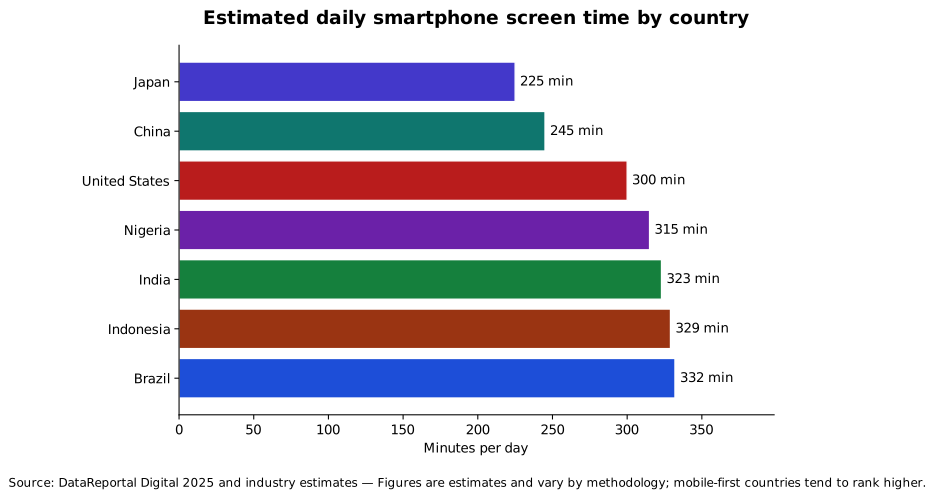
Estimated daily smartphone screen time by country. India sits near the top of global distributions alongside other mobile-first markets. Source: DataReportal Digital 2025, ITU Facts and Figures 2024.
This is partly because India went mobile-first and, in many households, mobile-only. Personal computers never reached most Indians; smartphones did. The Jio-era collapse in data prices turned access into habit. The result is that a large, young, price-sensitive population lives inside the same engagement architecture that operates in San Francisco, São Paulo, and Jakarta.
The scale matters because it makes the trade-offs visible. A few percentage points of attention shifted from entertainment to learning would translate into hundreds of millions of hours. A regulatory choice made for a billion users can reshape global product norms.
The Same Playbook, Cheaper Data
Point C2 Brazil, Indonesia, and Nigeria show similar patterns of mobile-first entertainment and platform concentration.
These countries followed a similar script. Mobile connectivity leapfrogged fixed-line infrastructure. Entertainment, messaging, and short-form video became the default uses. A small number of global platforms captured most of the attention. The ITU notes that lower-middle-income countries have driven recent internet-user growth, and the consumption mix in these markets skews heavily toward social and entertainment rather than productivity.
The common factor is not culture. It is economics and design. When data is cheap, devices are affordable, and platforms are optimized for time-on-site, the same behavior emerges. Local content fills the feeds, but the extraction playbook is imported. The languages change; the variable-reward loops do not.
This matters for how India thinks about solutions. A policy or product design that works in India is likely to work in other mobile-first, price-sensitive markets. Conversely, models designed for wealthy, PC-era societies may not transfer cleanly.
The Platform Powers Are Not Exempt
Point C3 The US and China have larger domestic platform ecosystems but face similar debates about youth screen time and platform accountability.
American firms wrote the attention-extraction playbook. Chinese firms refined recommendation algorithms and super-app engagement at massive scale. Both now face public debates over youth screen time, mental health, and platform accountability.
The United States has moved toward Section 230 reform, state-level age-appropriate design laws, and Federal Trade Commission actions against dark patterns and data practices. China has imposed gaming limits for minors and content-recommendation regulations. Neither has solved the problem, but both show that even the largest ecosystems are being asked to account for the time they capture.
India does not have to copy either model. But it can learn from both. From the United States, it can see that self-regulation has limits and that piecemeal litigation is slow. From China, it can see that regulatory will can change product defaults quickly, even if the costs to speech and privacy may be unacceptable under India’s constitutional framework.
Regulation as a Shared Experiment
Point C4 India’s regulatory choices—DSA-style due diligence, app-store rules, data protection—will shape how the global South addresses extraction.
India’s regulatory choices are being watched. The Digital Personal Data Protection Act, 2023, the revised Information Technology intermediary rules with due-diligence obligations, and app-store policies are early attempts to define responsibility for platform design. These rules borrow from the European Union’s Digital Services Act—risk assessments, transparency reports, grievance mechanisms—but adapt them to India’s capacity and constitutional framework.
If they work, they become a template for the global South. If they are weak, captured by industry, or unevenly enforced, they become a cautionary tale. The point is not that India will solve the global attention economy on its own. The point is that India’s scale means its choices matter beyond its borders.
Sources and Method
This article draws on global digital-overviews (DataReportal Digital 2025, ITU Facts and Figures 2024), regulatory texts (EU Digital Services Act, India’s Digital Personal Data Protection Act 2023 and revised IT intermediary rules), and comparative public-policy literature. Where India-specific figures appear, they come from the same sources used elsewhere in this series. Causal claims are avoided where underlying data is correlational or cross-sectional.
Related in This Series
- By the Numbers: What Indians Actually Do Online — the Indian usage mix that makes the global comparison necessary.
- Historical Hinges: When Access to a Tool Did Not Guarantee Its Benefits — why the current moment resembles earlier technology transitions.
- Regulation as a Floor: DSA, IT Rules, and DPDP — a closer look at India’s emerging regulatory framework.
- Attention, Substance, and the AI Moment — the full series guide and reading paths.
Article guideImportant points and sources4 pointsShow guideHide guide
- C001core · medium-high · verifiedIndia ranks among the highest countries for daily smartphone screen time.
- C002landscape · medium-high · verifiedBrazil, Indonesia, and Nigeria show similar patterns of mobile-first entertainment and platform concentration.
- C003landscape · medium-high · verifiedThe US and China have larger domestic platform ecosystems but face similar debates about youth screen time and platform accountability.
- C004argument · medium · verifiedIndia's regulatory choices—DSA-style due diligence, app-store rules, data protection—will shape how the global South addresses extraction.
SourcesSources used7 sourcesShow sourcesHide sources
- DataReportal: Digital 2025 Global Overview Reportindustry-report
- ITU: Facts and Figures 2024government-report
- EU Digital Services Actgovernment-report
- U.S. Surgeon General: Social Media and Youth Mental Health Advisorygovernment-report
- China CAC: Provisions on the Management of Algorithmic Recommendations in Internet Information Servicesgovernment-report
- India: Digital Personal Data Protection Act, 2023government-report
- India: Information Technology (Intermediary Guidelines and Digital Media Ethics Code) Rules, 2021government-report
Look closer
Sources and notes
Open detailsClose details
Look closer
Sources and notes
These notes collect the sources, counterpoints, and review status behind the article's important points. Read the essay first; open this when you want to check something.
Confidence reflects how strongly the sources support the point (low / medium / high). Status describes the point's role (e.g., core, argument, landscape). Sources link to supporting material;counterpoints note boundary conditions or conflicting findings.
India ranks among the highest countries for daily smartphone screen time.
verifiedreviewed 2026-07-18
- Sources (2)
“DataReportal's Digital 2025 Global Overview Report places India among the highest countries for average daily time spent on mobile devices.”
DataReportal: Digital 2025 Global Overview Reportdirect“The ITU Facts and Figures 2024 report notes that lower-middle-income countries, including India, have driven recent internet-user growth and show high mobile engagement.”
ITU: Facts and Figures 2024indirect
- Counterpoints (1)
Screen-time rankings vary by survey methodology, device definition, and sample population; India's exact global rank is sensitive to these choices.
Brazil, Indonesia, and Nigeria show similar patterns of mobile-first entertainment and platform concentration.
verifiedreviewed 2026-07-18
- Sources (2)
“ITU Facts and Figures 2024 highlights that emerging economies in Asia, Africa, and Latin America have grown fastest in internet access, with mobile as the primary mode and entertainment as a leading use case.”
ITU: Facts and Figures 2024direct“DataReportal's country-level data shows comparable daily mobile usage and social-media dominance in Brazil, Indonesia, Nigeria, and India.”
DataReportal: Digital 2025 Global Overview Reportdirect
- Counterpoints (1)
Each market has distinct language, income, and regulatory contexts; platform concentration is similar but not identical, and local competitors matter in some regions.
The US and China have larger domestic platform ecosystems but face similar debates about youth screen time and platform accountability.
verifiedreviewed 2026-07-18
- Sources (3)
“The U.S. Surgeon General's 2023 advisory on social media and youth mental health warns that current evidence is sufficient to justify concern and action on platform design.”
U.S. Surgeon General: Social Media and Youth Mental Health Advisorydirect“China's CAC provisions on algorithmic recommendations and minor-protection rules reflect government efforts to limit excessive youth screen time and platform power.”
China CAC: Provisions on the Management of Algorithmic Recommendations in Internet Information Servicesdirect“The EU Digital Services Act imposes due-diligence, transparency, and risk-management obligations on large platforms, reflecting a broader global turn toward platform accountability.”
EU Digital Services Actindirect
- Counterpoints (1)
The US and China differ sharply in legal tradition, enforcement capacity, and speech protections; their regulatory models are not directly transferable to India.
India's regulatory choices—DSA-style due diligence, app-store rules, data protection—will shape how the global South addresses extraction.
verifiedreviewed 2026-07-18
- Sources (3)
“India's Digital Personal Data Protection Act, 2023 establishes consent-based data processing and children's data protections, creating a baseline for platform design obligations.”
India: Digital Personal Data Protection Act, 2023direct“The revised Information Technology (Intermediary Guidelines and Digital Media Ethics Code) Rules, 2021 introduce due-diligence, grievance, and transparency obligations for intermediaries.”
India: Information Technology (Intermediary Guidelines and Digital Media Ethics Code) Rules, 2021direct“The EU Digital Services Act provides a reference model for due-diligence and risk-assessment regimes that India's rules partially adapt.”
EU Digital Services Actanalogous
- Counterpoints (1)
India's regulatory capacity, judicial backlog, and industry influence may limit enforcement; other global South countries may follow different models, such as ASEAN or African Union frameworks.
Review recordHow this was madeShow detailsHide details
Created 2026-07-05 by human. Policy: policy:default v1.0.0.
✓ Approved hash matches current article
Reviews
- humanapproved2026-07-05
Scope: thesis, claims, tone, privacy, sources
contentHash:
5742b77c6207ba7f…Human author approved publication.
- humanapproved2026-07-18
Scope: article
contentHash:
c6198bc61d361dc0…Re-approved by maintainer after the meta#61 P2 series migration (hardcoded kicker strip + arc reorder; no prose change beyond the kicker line; issue #124 instruction).
Machine-readable files
The same points, sources, and relationships are also available as structured files for agents and tools. The JSON follows thepublication record schema.