For the first two decades of India’s internet, the default user was imagined as English-speaking, urban, and male. That image is now outdated. The country’s internet has become rural-majority, mobile-first, and—above all—Indic-language. The shift is a genuine access success: hundreds of millions of people can now read, watch, and speak in the languages they use at home. But the same infrastructure has also become a much larger surface for attention extraction.
Point C1 The shift to an Indic-language, mobile-first internet multiplied India’s online population, but it also multiplied the surface area for attention extraction, because the same engagement-optimized feed designs now operate across dozens of languages with weaker local safety, quality, and creator-economy supports.
The Language Flip
India had roughly 886 million active internet users in 2024, according to the Internet in India Report 2024 jointly prepared by IAMAI and Kantar. Nearly all of them—98 percent—accessed content in Indic languages. Point C2 The figure is not only a rural story: 57 percent of urban internet users said they prefer consuming content in regional languages.
The most popular languages were Tamil, Telugu, and Malayalam, according to the report, largely because content availability is already strong in those languages. Hindi and other major languages follow. The point is not that any one language dominates; it is that the internet is no longer a single English-dominant space with regional niches. It is a federation of vernacular feeds, each with its own creators, influencers, WhatsApp groups, and recommendation algorithms.
This matters for the attention-economy argument. When platforms expand from serving 150 million English-speaking users to serving 800 million-plus Indic-language users, the business model does not change—it scales. The same ad-revenue, time-on-platform, and engagement-maximization logic now reaches many more people, many of whom are newer to digital media and less likely to have encountered counter-programming such as media literacy, fact-checking, or privacy literacy in their own languages.
Rural, Mobile, and Shared
The language shift is tied to a geography shift. Rural India now accounts for 488 million internet users, or 55 percent of the total user base, and rural growth is running at roughly twice the pace of urban growth. Point C3 The average Indian internet user spent about 90 minutes online per day in 2024, with urban users slightly above that average.
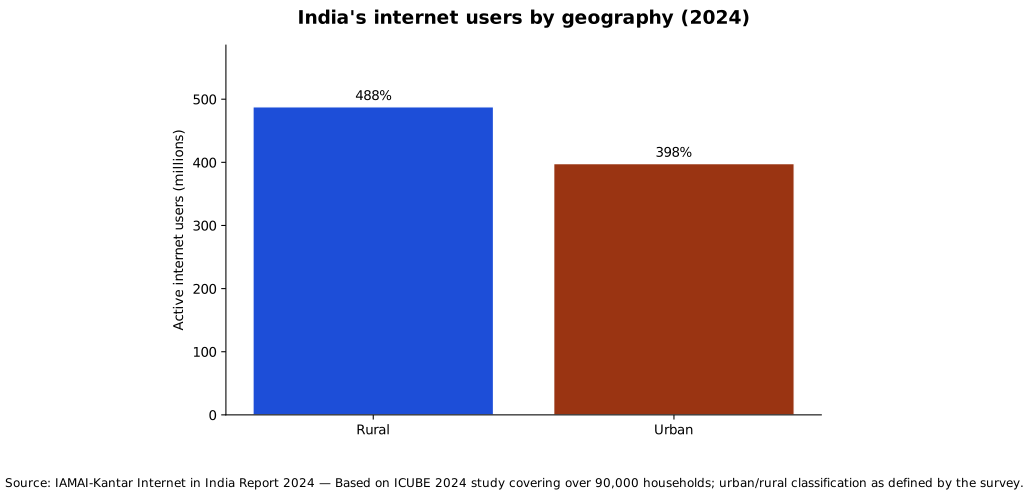
Source: IAMAI-Kantar Internet in India Report 2024 (ICUBE 2024, n=90,000+ households). Urban/rural classification as defined by the survey; totals may not sum to 886 million due to rounding.
Mobile devices remain the primary access point, and shared-device use is common, especially among women and users under 19. That shared-device pattern matters: it can mean less individual privacy, more family-curated or algorithm-curated content, and fewer personalized controls. A teenager using a parent’s phone, or a family member using a single shared smartphone, may not have the same ability to set limits, manage notifications, or choose higher-quality defaults.
Vernacular Platforms at Scale
The demand showed up in platforms built for it. ShareChat, a social media platform designed around Indian languages, reported more than 350 million active users as of 2025, with 90 percent of them consuming content in local languages. Point C4 Dailyhunt, a vernacular news aggregator, has long positioned itself around the fact that nearly 70 percent of Indians speak non-English languages.
These are not small experiments. They are national-scale platforms. ShareChat and its short-video sibling Moj together operate across 15 Indian languages. The fact that a vernacular social platform can reach hundreds of millions of users means the design questions that apply to Meta, Google, and ByteDance also apply here: what the feed optimizes for, how long it keeps users watching, what kind of content gets algorithmically amplified, and what safeguards exist for hate speech, misinformation, and addictive use patterns.
The Extraction Multiplier
The vernacular internet did not invent a gentler business model. It imported the same one: ad-supported, engagement-optimized, infinite-scroll feeds. Point C5 Short-form video, autoplay, push notifications, streaks, and algorithmic recommendations work as well in Bhojpuri and Kannada as they do in English and Hindi. The psychological mechanisms—variable rewards, social comparison, fear of missing out—are language-agnostic.
What is different is the supply side of quality and safety. There are fewer fact-checkers fluent in smaller languages, smaller independent newsrooms with the resources to fight legal or algorithmic takedowns, and weaker creator-economy infrastructure outside the largest languages. Point C6 A misleading health video in English may be flagged quickly by multiple actors; the same video in a less-resourced language can circulate longer before anyone with authority notices.
This is not a claim that Indic-language internet users are more gullible. It is a claim about information-ecology resourcing. The same extraction pressure is applied to a landscape with fewer quality signals and fewer moderators who understand local context, dialect, and political nuance.
What Gets Lost in Translation
The gap between access and quality shows up in what is easy to find versus what is hard. Entertainment, religion, astrology, health claims, and political outrage translate easily into short video and memes. Nuanced public-interest reporting, educational scaffolding, mental-health resources, and civic information are harder to produce at scale in 22 officially recognized languages and hundreds of dialects.
The result is a skewed vernacular internet: high on emotion and low on structured knowledge. A student in a small town can watch a physics video in her own language, but she is more likely to encounter a feed optimized to keep her watching than one optimized to help her learn. The problem is not the language; it is the mismatch between the languages people speak and the incentives of the platforms that serve them.
The Opportunity: Bhashini and Beyond
There is a counter-narrative, and it is not fantasy. The Indian government’s Bhashini platform aims to make digital services available across Indian languages through translation, speech recognition, and text-to-speech. As of late 2024, Bhashini reported more than 100 million inferences per month and translation services in 22 scheduled Indian languages. Point C7
If these language tools mature, they could lower the cost of producing high-quality educational, civic, and health content in many more languages. AI translation and voice interfaces could make it easier for a farmer to access a government scheme, a student to ask a question in her mother tongue, or a local journalist to reach a wider audience. But access and translation are inputs, not outcomes. They make substance possible; they do not make it profitable. Without changes to platform incentives, the same translation technology can also be used to generate more low-quality content faster.
What This Article Does Not Claim
This article does not claim that Indic-language content is inherently lower quality than English content. Some of India’s most rigorous journalism, most creative art, and most effective education happens in Indian languages. The concern is about the structural conditions under which most vernacular feeds currently operate.
It also does not claim that users are passive. People select content, ignore recommendations, and teach one another how to spot false claims. But individual resistance is easier when the surrounding information environment has quality signals—trusted publishers, accessible fact-checkers, and platform designs that do not systematically reward outrage and novelty.
Sources and Method
This article draws on the IAMAI-Kantar Internet in India Report 2024, based on the ICUBE 2024 study covering over 90,000 households across India (except Lakshadweep). Secondary coverage from Entrepreneur India and BW Businessworld was used to verify headline figures. Platform-scale references draw on industry reporting about ShareChat and Dailyhunt. Government language-technology figures come from the Press Information Bureau year-end review for MeitY and the Bhashini website. Where a source is industry-reported rather than independently audited, the text says so.
Open Questions
- How much of the vernacular internet’s attention skew is driven by platform design versus by advertiser demand and creator supply?
- Which Indian languages have the strongest independent fact-checking and quality-journalism ecosystems, and which are underserved?
- Can AI translation and voice interfaces improve the ratio of substance to extraction, or will they mainly accelerate low-cost content production?
- What design changes would make vernacular feeds more useful for learning, health, and civic participation without being paternalistic?
- How should Indian regulators think about language-specific accountability when platforms operate across dozens of languages?
Related in This Series
- The Attention Extraction — the overview and thesis of the diagnosis.
- By the Numbers: What Indians Actually Do Online — the country’s digital time budget across entertainment, education, work, and communication.
- The Generational Bet — why the AI moment makes attention choices a national stake.
- The Substance Builder — practical paths for turning dead time into small acts of creation.
- Designing for Substance — how platform incentives and regulation could make substance the easier path.
- Attention, Substance, and the AI Moment: A Series Index — the full series guide and reading paths.
Article guideImportant points and sources7 pointsShow guideHide guide
- C001core · high · verifiedThe shift to an Indic-language, mobile-first internet multiplied India's online population, but it also multiplied the surface area for attention extraction, because the same engagement-optimized feed designs now operate across dozens of languages with weaker local safety, quality, and creator-economy supports.
- C002core · high · verifiedThe IAMAI-Kantar Internet in India Report 2024 found that 98 percent of Indian internet users accessed content in Indic languages, with 57 percent of urban users preferring regional-language content.
- C003landscape · high · verifiedRural India accounted for 488 million internet users, or 55 percent of the total active user base, in 2024, and rural growth outpaced urban growth.
- C004landscape · medium · verifiedVernacular platforms such as ShareChat and Dailyhunt operate at national scale, with ShareChat reporting more than 350 million active users and 90 percent of them consuming local-language content as of 2025.
- C005core · high · verifiedThe same engagement-optimized designs—infinite scroll, autoplay, algorithmic recommendations, push notifications, and streaks—that shape English and Hindi feeds now operate across dozens of Indic languages.
- C006core · medium · contestedIndic-language content ecosystems have fewer local fact-checkers, moderators, and creator-economy supports than English/Hindi ecosystems, creating weaker quality and safety signals.
- C007framing · medium · verifiedGovernment language-technology initiatives such as Bhashini and AI translation could lower friction for quality vernacular content, but access and translation alone do not guarantee substance.
SourcesSources used6 sourcesShow sourcesHide sources
- IAMAI-Kantar: Internet in India Report 2024industry-report
- BW Businessworld: India Set To Reach 900 Mn Internet Users By 2025news-article
- AtomComm: Why Regional Language Content is the Next Big Thing for Indian Digital Campaignsindustry-article
- Forbes India: We solved ML for vernacular Indian languages early on—Dailyhuntnews-article
- PIB: Year End Review 2024 of Ministry of Electronics & Information Technologygovernment-press-release
- Bhashini: AI-driven Indian language translation servicesgovernment-website
Look closer
Sources and notes
Open detailsClose details
Look closer
Sources and notes
These notes collect the sources, counterpoints, and review status behind the article's important points. Read the essay first; open this when you want to check something.
Confidence reflects how strongly the sources support the point (low / medium / high). Status describes the point's role (e.g., core, argument, landscape). Sources link to supporting material;counterpoints note boundary conditions or conflicting findings.
The shift to an Indic-language, mobile-first internet multiplied India's online population, but it also multiplied the surface area for attention extraction, because the same engagement-optimized feed designs now operate across dozens of languages with weaker local safety, quality, and creator-economy supports.
verifiedreviewed 2026-07-18
- Sources (2)
“India reached 886 million active internet users in 2024, with 98% accessing content in Indic languages and rural India accounting for 55% of users.”
IAMAI-Kantar: Internet in India Report 2024direct“ShareChat reported over 350 million active users as of 2025, with 90% consuming content in local languages, indicating national scale for vernacular feeds.”
AtomComm: Why Regional Language Content is the Next Big Thing for Indian Digital Campaignsindirect
- Counterpoints (1)
Vernacular platforms also host education, agriculture, and civic content; the problem is the incentive structure and quality resourcing, not the language itself.
The IAMAI-Kantar Internet in India Report 2024 found that 98 percent of Indian internet users accessed content in Indic languages, with 57 percent of urban users preferring regional-language content.
verifiedreviewed 2026-07-18
- Sources (1)
“Nearly all internet users (98%) accessed content in Indic languages, with Tamil, Telugu, and Malayalam emerging as the most popular. Over half (57%) of urban internet users prefer consuming content in regional languages.”
IAMAI-Kantar: Internet in India Report 2024direct
- Counterpoints (1)
The 98% figure measures access, not exclusive use; many users switch between English and Indic languages depending on context.
Rural India accounted for 488 million internet users, or 55 percent of the total active user base, in 2024, and rural growth outpaced urban growth.
verifiedreviewed 2026-07-18
- Sources (1)
“Rural India, with 488 million users, leads this growth and now accounts for 55% of the total internet population. Rural growth is occurring at twice the pace of urban regions.”
IAMAI-Kantar: Internet in India Report 2024direct
- Counterpoints (1)
Urban users still lead in digital commerce, payments, and online education; rural dominance is in volume and entertainment/communication use, not in all categories.
Vernacular platforms such as ShareChat and Dailyhunt operate at national scale, with ShareChat reporting more than 350 million active users and 90 percent of them consuming local-language content as of 2025.
verifiedreviewed 2026-07-18
- Sources (2)
“As of 2025, ShareChat has over 350 million active users, 90% of whom consume content in local languages.”
AtomComm: Why Regional Language Content is the Next Big Thing for Indian Digital Campaignsdirect“Dailyhunt's product-market fit rests on the fact that nearly 70% of the Indian population speaks non-English languages.”
Forbes India: We solved ML for vernacular Indian languages early on—Dailyhuntindirect
- Counterpoints (1)
ShareChat's active-user figure is industry-reported and has not been independently audited; definitions of 'active user' vary across platforms.
The same engagement-optimized designs—infinite scroll, autoplay, algorithmic recommendations, push notifications, and streaks—that shape English and Hindi feeds now operate across dozens of Indic languages.
verifiedreviewed 2026-07-18
- Sources (2)
“Regional language content is central to the digital experience, with entertainment, streaming, social media, and communication dominating usage across urban and rural demographics.”
IAMAI-Kantar: Internet in India Report 2024indirect“ShareChat and similar platforms support content in 15 Indian languages and attract users from non-metro cities, applying the same feed-based engagement model at scale.”
AtomComm: Why Regional Language Content is the Next Big Thing for Indian Digital Campaignsindirect
- Counterpoints (1)
Some vernacular platforms emphasize community and local creators, which can produce healthier interaction patterns than global platforms.
Indic-language content ecosystems have fewer local fact-checkers, moderators, and creator-economy supports than English/Hindi ecosystems, creating weaker quality and safety signals.
contestedreviewed 2026-07-18
- Sources (2)
“With 98% of 886 million users accessing Indic-language content across dozens of languages, the scale of vernacular content far exceeds the documented supply of language-specific moderation and fact-checking capacity.”
IAMAI-Kantar: Internet in India Report 2024indirect“ShareChat alone reports 350 million active users across 15 Indian languages, illustrating that platform-scale vernacular operations now require safety and quality infrastructure that has not been publicly documented.”
AtomComm: Why Regional Language Content is the Next Big Thing for Indian Digital Campaignsindirect
- Counterpoints (1)
Independent fact-checkers and citizen-led verification networks exist in several Indian languages; coverage is uneven but not absent.
Government language-technology initiatives such as Bhashini and AI translation could lower friction for quality vernacular content, but access and translation alone do not guarantee substance.
verifiedreviewed 2026-07-18
- Sources (1)
“BHASHINI is bridging language barriers for accessible digital services with 100 million+ inferences per month; translation services are available in 22 scheduled Indian languages.”
PIB: Year End Review 2024 of Ministry of Electronics & Information Technologydirect
- Counterpoints (1)
Translation technology can also accelerate spam, low-quality content, and misinformation at scale if quality controls are not built in.
Review recordHow this was madeShow detailsHide details
Created 2026-07-05 by human. Policy: policy:default v1.0.0.
Researched, drafted, and structured with AI agents; approved for publication by a human reviewer.
✓ Approved hash matches current article
Reviews
- humanapproved2026-07-05
Scope: thesis, claims, tone, privacy, sources
contentHash:
34a702fd058cd8a3…Human author approved publication.
- humanapproved2026-07-18
Scope: article
contentHash:
7d387f32e4a3846d…Re-approved by maintainer after the meta#61 P2 series migration (hardcoded kicker strip + arc reorder; no prose change beyond the kicker line; issue #124 instruction).
Machine-readable files
The same points, sources, and relationships are also available as structured files for agents and tools. The JSON follows thepublication record schema.