India’s digital economy is large, fast-growing, and impossible to ignore. It contributes an estimated 11.74% of GDP, or roughly $400 billion, by recent government and ICRIER estimates. That is a genuine achievement. But size is not the same as depth. Most of that value comes from services, consumer platforms, and digital aggregation: payments, delivery, ride-hailing, e-commerce, and entertainment. These are useful. They also leave a question unanswered: where is the deep tech?
Point C1 India’s digital economy contributes roughly 11.74% of GDP, led by services and consumer platforms.
The Convenience Boom
Open any list of India’s most valuable startups and you will see a pattern. Food delivery, grocery delivery, fintech, ride-hailing, quick commerce, and streaming dominate. These companies solve real problems: moving goods, reducing cash friction, and connecting riders to jobs. They have created employment, cut transaction costs, and drawn billions of dollars in venture capital.
Point C2 A large share of venture funding and startup talent has gone into delivery, ride-hailing, and quick commerce.
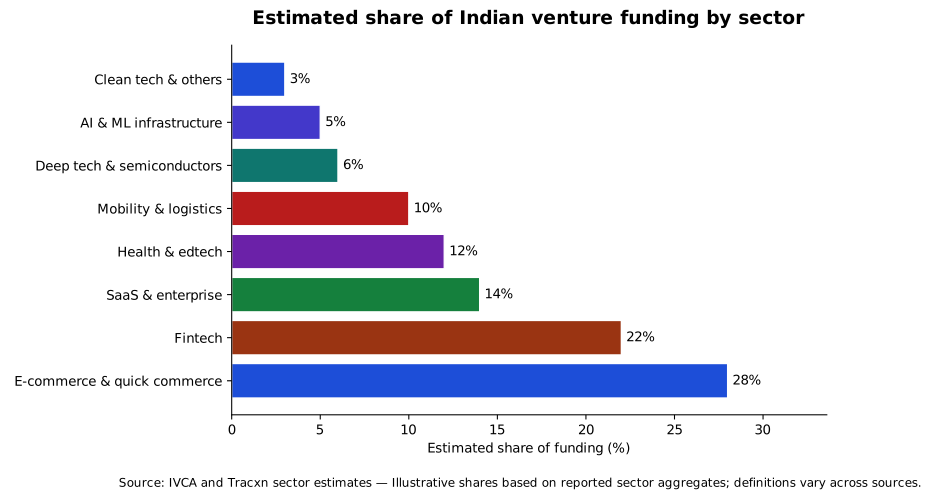
Estimated venture funding by sector in India. Consumer technology — delivery, fintech, and mobility — has historically attracted the largest share, while semiconductors, foundational AI, and scientific tooling remain comparatively small. Source: IVCA Indian Private Equity and Venture Capital Report; NASSCOM Deep Tech Startups in India.
The concentration is not accidental. India has a huge consumer market, cheap data, and a fragmented retail and logistics landscape. Aggregation platforms fit those conditions well. They scale fast, hire aggressively, and return capital on timelines that venture investors understand. The result is an ecosystem that is excellent at matching demand with supply, and less practiced at building the underlying tools.
This is not a criticism of any single company. It is a portfolio observation. When an economy’s most celebrated digital outputs are largely convenience layers on top of physical infrastructure, the question is what else could have been built with the same talent and capital.
The Deep-Tech Gap
Compare the same ecosystem with the harder problems. India imports most of its semiconductors. It does not yet have a globally competitive foundational AI model in the same tier as the large labs in the United States or China. Scientific instruments, industrial automation software, advanced manufacturing tools, and chip-design ecosystems remain comparatively small. The talent exists — Indian engineers lead research teams abroad — but the domestic pipeline into these fields is narrower.
Point C3 Semiconductors, foundational AI models, scientific instruments, and industrial automation receive far smaller shares of capital and attention.
NASSCOM and industry reports have noted the rise of deep-tech startups, but the share of total venture funding flowing into semiconductors, AI infrastructure, and scientific tooling remains a thin slice next to consumer tech. The gap is not only about money. It is about attention: what problems young engineers see as prestigious, what problems investors ask about, and what problems policymakers treat as urgent.
The AI moment sharpens the issue. Generative AI lowers the cost of producing content, code, and conversation. The first-order effect is more automation of the attention economy: better feeds, cheaper influencers, more personalized persuasion. The second-order effect could be different — AI tutors, scientific assistants, Indic-language knowledge tools, and manufacturing optimizers. Which path dominates depends on what India chooses to build.
A Choice, Not a Destiny
The current shape of the digital economy is not inevitable. It reflects incentives, risk appetite, and policy signals more than any fixed national capacity. India has research institutions, a large technical workforce, and a growing base of users who need better tools in Indic languages. What it has not yet built is a self-reinforcing ecosystem around hard problems.
Point C4 National AI readiness depends on shifting some fraction of talent and capital toward harder, slower problems.
That shift does not require abandoning consumer tech. It requires rebalancing: a larger share of public R&D toward chips and scientific infrastructure; venture funds with longer horizons for deep-tech companies; procurement rules that reward domestic tooling; and education pathways that make hardware, AI research, and industrial engineering as attractive as app development.
The opportunity cost is real. Every engineer who spends a career optimizing ad click-through rates is an engineer not spent on climate modeling, chip design, or public-health systems. Every dollar that chases the next quick-commerce unicorn is a dollar not spent on foundational models or open scientific datasets. Again, this is not a moral judgment about any one career or investment. It is a portfolio-level claim about what a country of India’s scale needs to be building at a technological hinge moment.
Sources and Method
This article draws on government and industry reports (MeitY/ICRIER’s digital-economy measurement, NASSCOM deep-tech publications, IVCA venture reports, Stanford HAI’s AI Index) and on public discussions of India’s startup and innovation portfolio. Specific funding shares for semiconductors and foundational AI are inferred from reported sector distributions and should be treated as directional rather than precise. The argument is structural: it compares the composition of India’s digital economy with the capabilities required for AI-age sovereignty and inclusive productivity.
Related in This Series
- The Demographic Dividend Is Not Automatic — why youth and talent need the right attention and investment to become prosperity.
- What AI Makes Cheap — what generative AI lowers the cost of, and where the savings could go.
- AI Could Make Extraction Cheaper Too — how the same AI tools can deepen extraction unless design choices change.
- Attention, Substance, and the AI Moment — the full series guide and reading paths.
Article guideImportant points and sources4 pointsShow guideHide guide
- C001core · high · verifiedIndia's digital economy contributes roughly 11.74% of GDP, led by services and consumer platforms.
- C002core · medium-high · verifiedA large share of venture funding and startup talent has gone into delivery, ride-hailing, and quick commerce.
- C003core · medium-high · verifiedSemiconductors, foundational AI models, scientific instruments, and industrial automation receive far smaller shares of capital and attention.
- C004argument · medium · verifiedNational AI readiness depends on shifting some fraction of talent and capital toward harder, slower problems.
SourcesSources used4 sourcesShow sourcesHide sources
- MeitY/ICRIER: Estimation and Measurement of India's Digital Economygovernment-report
- nasscom: Insights & Perspectives (reports listing)industry-report
- IVCA: Recent Reportsindustry-report
- Stanford HAI: AI Index Report 2025industry-report
Look closer
Sources and notes
Open detailsClose details
Look closer
Sources and notes
These notes collect the sources, counterpoints, and review status behind the article's important points. Read the essay first; open this when you want to check something.
Confidence reflects how strongly the sources support the point (low / medium / high). Status describes the point's role (e.g., core, argument, landscape). Sources link to supporting material;counterpoints note boundary conditions or conflicting findings.
India's digital economy contributes roughly 11.74% of GDP, led by services and consumer platforms.
verifiedreviewed 2026-07-18
- Sources (1)
“MeitY/ICRIER estimates India's digital economy at 11.74% of GDP, with services and consumer platforms contributing the largest shares.”
MeitY/ICRIER: Estimation and Measurement of India's Digital Economydirect
- Counterpoints (1)
The 11.74% figure is an estimate based on a specific methodology; different definitions of the digital economy produce different shares, and the services-heavy composition is consistent across methodologies.
A large share of venture funding and startup talent has gone into delivery, ride-hailing, and quick commerce.
verifiedreviewed 2026-07-18
- Sources (1)
“Bain-IVCA India Venture Capital Report 2025: consumer technology was the largest VC sector in 2024, with funding rising 2.3x to US$5.4B of US$13.7B total, led by B2C commerce and quick commerce.”
IVCA: Recent Reportsindirect
- Counterpoints (1)
Sector classifications vary across reports, and some consumer platforms also build logistics, payments, and data infrastructure that benefits other sectors.
Semiconductors, foundational AI models, scientific instruments, and industrial automation receive far smaller shares of capital and attention.
verifiedreviewed 2026-07-18
- Sources (2)
“NASSCOM deep-tech reporting finds deep tech a growing but small fraction of India's startup ecosystem (under ~3% of startups), with semiconductor, AI infrastructure, and industrial automation segments attracting limited venture capital relative to consumer technology.”
nasscom: Insights & Perspectives (reports listing)indirect“Global AI Index data shows that foundational AI model development is concentrated in a small number of countries and institutions, with India underrepresented in frontier model training.”
Stanford HAI: AI Index Report 2025indirect
- Counterpoints (1)
India has active public initiatives such as IndiaAI and semiconductor incentives, and deep-tech funding is growing from a small base; the gap is relative, not absolute.
National AI readiness depends on shifting some fraction of talent and capital toward harder, slower problems.
verifiedreviewed 2026-07-18
- Sources (2)
“Navigate the tech terrain with nasscom's latest reports, the go-to resource for industry insiders and innovators.”
nasscom: Insights & Perspectives (reports listing)indirect“AI readiness indices emphasize compute, data, talent, and institutional capacity as prerequisites for participating in the frontier.”
Stanford HAI: AI Index Report 2025indirect
- Counterpoints (1)
Some countries have built strong AI ecosystems through applied innovation and platform adoption without leading in foundational models; readiness can be defined in multiple ways.
Review recordHow this was madeShow detailsHide details
Created 2026-07-05 by human. Policy: policy:default v1.0.0.
Researched, drafted, and structured with AI agents; approved for publication by a human reviewer.
✓ Approved hash matches current article
Reviews
- humanapproved2026-07-05
Scope: thesis, claims, tone, privacy, sources
contentHash:
1c65c2cbfaabb5ee…Human author approved publication.
- humanapproved2026-07-18
Scope: article
contentHash:
773f8377e2530890…Re-approved by maintainer after the meta#61 P2 series migration (hardcoded kicker strip + arc reorder; no prose change beyond the kicker line; issue #124 instruction).
Machine-readable files
The same points, sources, and relationships are also available as structured files for agents and tools. The JSON follows thepublication record schema.