For a generation coming of age on short-form video, the path to success looks open. A phone, an idea, and persistence are said to be enough. The creator economy is sold as a democratized career: no gatekeepers, no degrees, no capital. In India, that story has real scale behind it. But scale is not the same as sustainability, and access to a platform is not the same as a living wage.
Point C1 India’s creator economy has reached mainstream scale, yet its promise of accessible entrepreneurship masks a power-law payout structure that diverts young talent from skill-building at the very moment India needs to compound its AI opportunity.
The Scale of the Dream
The numbers are impressive. According to BCG’s From Content to Commerce: Mapping India’s Creator Economy, India has an estimated 2–2.5 million monetized creators who influence $350–400 billion in annual consumer spending. That influence is projected to cross $1 trillion by 2030, with ecosystem revenues potentially reaching $100–125 billion over the next five years.
Point C2 BCG estimates that India has 2–2.5 million monetized creators influencing $350–400 billion in annual consumer spending, with that influence projected to exceed $1 trillion by 2030.
The report, based on quantitative research covering 1,900+ consumers and 60+ brands, defines a creator as someone with more than 1,000 followers who is actively monetizing. By that definition, the ecosystem is already large. Brands plan to scale creator budgets by 1.5–3x in the next two to three years. Lifestyle categories like fashion, beauty, and entertainment lead in influence. The creator economy is no longer a metro-Gen-Z sides story; it is a national market force.
But the same report notes a critical gap: only 8–10% of the 2–2.5 million creators effectively monetize their content. The rest are posting without pay, or earning amounts too small to count as income. The consumer-spending figure measures influence, not creator welfare. A creator who shapes a purchase decision is not necessarily a creator who can pay rent.
The Aspirational Majority
If the economics are uneven, the ambition is universal. A November 2025 survey reported by Exchange4Media found that 83% of Gen Z respondents in India identify as creators, and 80% want brands to engage with them as creators rather than only as consumers.
Point C3 A November 2025 survey found that 83% of Gen Z respondents in India identify as creators, making creator culture a default aspiration rather than a niche ambition.
This is a cultural shift as much as an economic one. BCG’s separate study on Gen Z in India notes that roughly 70% of Gen Zers use creators’ channels as search destinations — they turn to creators for product discovery, learning, and lifestyle decisions before they turn to traditional search or brand channels. The creator is no longer just an entertainer; for many young Indians, the creator is the default model of success.
That model is not irrational. The top of the pyramid is highly visible. A small number of Indian creators have built national followings, brand empires, and venture-funded companies. Their stories travel. What does not travel as easily is the arithmetic beneath them.
The Income Pyramid
Creator income follows a steep power law. Global compensation data from CreatorIQ’s State of Creator Compensation 2026 found that in 2025, the top 10% of creators earned 62% of total payments, while the top 1% earned 21%. The median creator earned $3,000 per campaign, even though the average was $11,400. Aggregate payments grew 59% year over year, but the gains concentrated at the top.
Point C4 Global creator-compensation data shows extreme income concentration: the top 10% of creators earned 62% of payments and the top 1% earned 21% in 2025, while median campaign earnings remained far below the average.
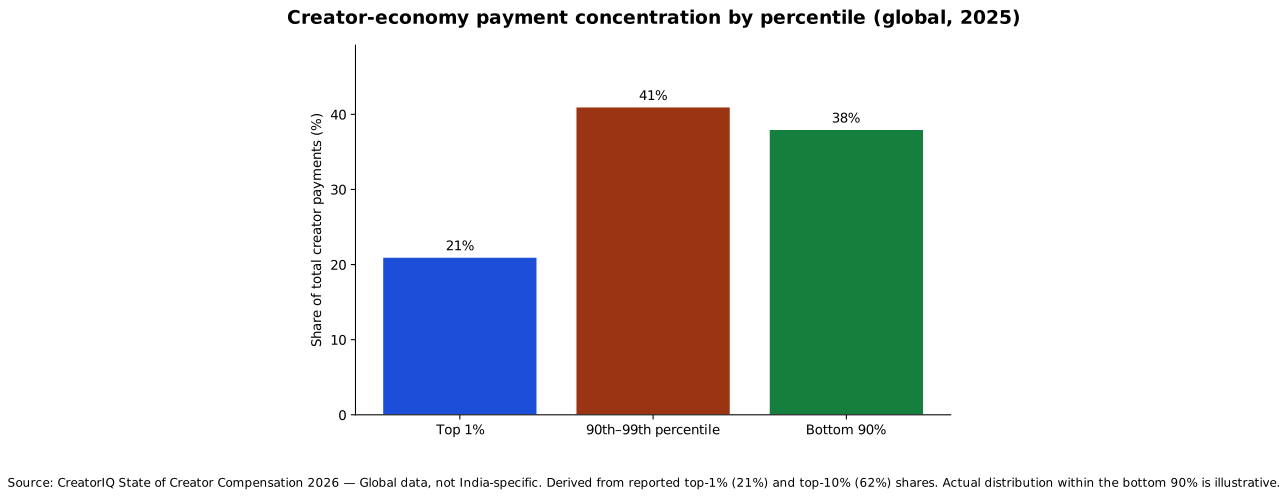
Source: CreatorIQ State of Creator Compensation 2026. Global data, not India-specific; illustrates the power-law structure of creator payments.
The chart above is global, not India-specific, but the structural lesson applies. In any platform market where attention is the scarce resource, a small number of winners capture most of the value. The median participant competes for the remainder. The result is an economy that looks abundant in aggregate but is thin at the middle.
India’s own advertising market makes the middle even thinner.
Why Indian Payouts Are So Thin
The same view count pays differently depending on where the viewer lives. Industry estimates of YouTube advertising rates put the average CPM in India at roughly $0.77, compared with roughly $36 in the United States — a spread of about 47 times. The gap reflects advertiser budgets, purchasing power, and the maturity of the digital ad market, not the quality of the creator.
Point C5 India’s digital advertising payouts are structurally lower than those in mature markets, with industry estimates placing YouTube CPM in India around $0.77 compared with roughly $36 in the US — a roughly 47-fold gap.
This has consequences. A creator in India needs many times more views than a US creator to earn the same ad revenue. Short-form video, where much of India’s creator activity lives, pays even less per view than long-form YouTube. YouTube Shorts RPM typically runs in cents, not dollars. Brand deals can help, but brand deals also concentrate among creators who can deliver reach and conversion — which, again, favors the top of the pyramid.
The platform structure reinforces the gap. Algorithms reward frequency, trend responsiveness, and emotional hooks. Creators who want to stay visible must post constantly, chase formats, and optimize for engagement rather than depth. The work is real, but much of it is spent competing for attention in a market where attention is cheap and advertiser payout per unit of attention is low.
AI Could Make the Trap Deeper
Generative AI changes the cost curve of content. It becomes cheaper to produce scripts, thumbnails, voiceovers, edits, and even synthetic personalities. That should help creators. But lowering production costs also lowers the barrier to entry, which increases competition. If anyone can generate a polished video, the value of polish falls. The scarce resource becomes not the ability to produce, but the ability to stand out.
Point C6 Generative AI lowers the cost of producing content, which can increase competition and flood feeds with synthetic media, deepening the incentive trap rather than solving it.
BCG’s creator-economy report flags generative AI as one of the transformative forces in the ecosystem. The risk is that AI becomes a tool for extraction at scale: synthetic influencers, hyper-personalized feeds, automated trend-chasing, and AI-generated content designed to harvest attention more efficiently than human creators can. In that scenario, the creator economy does not become a ladder for young talent; it becomes a more efficient machine for converting human attention into platform revenue.
The question is not whether AI will replace creators. The question is which AI future India builds: one that amplifies individual skill and originality, or one that floods the attention market with cheap, optimized content and makes sustainable creator careers even harder.
The Opportunity Cost
Every hour spent planning content, editing reels, chasing trends, and reading analytics is an hour not spent learning a technical skill, building a product, reading deeply, or practicing a craft. For a young country, that trade-off matters.
Point C7 For India’s young population, time spent chasing algorithmic visibility is time not spent building the rare, compoundable skills that the AI age rewards.
This is not an argument against creative careers. India needs storytellers, educators, journalists, artists, and entertainers. It also needs engineers, scientists, technicians, designers, and builders. The trap is not the existence of the creator economy; it is the default assumption that creator success is probable, and the cultural drift that pushes talented young people toward low-probability virality instead of high-probability skill accumulation.
The AI moment makes the distinction sharper. AI can already cheapen routine content production. What it cannot cheapen — at least not yet — is judgment, taste, domain expertise, and the ability to build things that matter over long time horizons. Those are the skills that compound. The creator economy, as it is currently structured, often asks young people to do the opposite: optimize for immediate attention and ephemeral metrics.
Sources and Method
This article draws on the BCG report From Content to Commerce: Mapping India’s Creator Economy (May 2025), which provides the headline scale figures for India’s creator base, consumer influence, monetization rate, and projected growth. The 83% Gen Z creator-identification figure comes from a November 2025 survey reported by Exchange4Media and BW Marketing World. Income-concentration data comes from CreatorIQ’s State of Creator Compensation 2026, which is global and is labeled as such. YouTube CPM estimates come from industry benchmarks compiled by upGrowth and reported via realsiteworth.com and ytface.com; these are approximate and vary by niche, audience, and ad format. BCG’s separate Gen Z study, The $2 Trillion Opportunity: How Gen Z Is Shaping the New India (October 2024), provides the finding that roughly 70% of Gen Zers use creator channels as search destinations.
Where figures are global benchmarks or industry estimates, the text says so. The article does not claim that all creator aspiration is misguided; it argues that the structure of the creator economy makes sustainable livelihoods unlikely for most participants, and that this structural gap has consequences for India’s AI opportunity.
Open Questions
- What share of Indian creators earn enough to treat creation as a primary livelihood, and how has that share changed as the market has matured?
- Can platform revenue-sharing models be redesigned to support a thicker middle tier of creators, or is power-law concentration inherent to attention markets?
- How will generative AI change the number of creators needed to saturate a given niche, and what skills will remain scarce?
- What would it take for Indian creator education to emphasize craft, judgment, and domain depth alongside reach and engagement?
- Could public or cooperative funding models reduce dependence on ad-supported platforms for cultural production?
Related in This Series
- The Attention Extraction — the overview and thesis of the diagnosis.
- By the Numbers: What Indians Actually Do Online — how India’s digital time budget is spent.
- The Generational Bet — the stakes of the AI moment for India’s young population.
- The Substance Builder — practical paths for turning dead time into skill-building.
- Designing for Substance — how platforms and policymakers could make substance the easier path.
- Attention, Substance, and the AI Moment — the full series guide and reading paths.
Article guideImportant points and sources7 pointsShow guideHide guide
- C001core · medium-high · verifiedIndia's creator economy has reached mainstream scale, yet its promise of accessible entrepreneurship masks a power-law payout structure that diverts young talent from skill-building at the very moment India needs to compound its AI opportunity.
- C002core · high · verifiedBCG estimates that India has 2–2.5 million monetized creators influencing $350–400 billion in annual consumer spending, with that influence projected to exceed $1 trillion by 2030.
- C003core · medium · verifiedA November 2025 survey found that 83% of Gen Z respondents in India identify as creators, making creator culture a default aspiration rather than a niche ambition.
- C004landscape · high · verifiedGlobal creator-compensation data shows extreme income concentration: the top 10% of creators earned 62% of payments and the top 1% earned 21% in 2025, while median campaign earnings remained far below the average.
- C005core · medium · verifiedIndia's digital advertising payouts are structurally lower than those in mature markets, with industry estimates placing YouTube CPM in India around $0.77 compared with roughly $36 in the US — a roughly 47-fold gap.
- C006framing · medium · verifiedGenerative AI lowers the cost of producing content, which can increase competition and flood feeds with synthetic media, deepening the incentive trap rather than solving it.
- C007core · medium · verifiedFor India's young population, time spent chasing algorithmic visibility is time not spent building the rare, compoundable skills that the AI age rewards.
SourcesSources used8 sourcesShow sourcesHide sources
- BCG: From Content to Commerce: Mapping India's Creator Economyindustry-report
- BCG: From Content to Commerce: Mapping India's Creator Economy (publication page)industry-report
- BCG: The $2 Trillion Opportunity: How Gen Z Is Shaping the New Indiaindustry-report
- Exchange4Media: 83% Gen Z create content and 80% want brands playing alongnews-report
- BW Marketing World: Most Gen Z Are Now Content Creators, With 80% Seeking Brand Involvementnews-report
- CreatorIQ: State of Creator Compensation 2026industry-report
- Real Site Worth: YouTube RPM vs CPM — what each one actually meansindustry-report
- YTface: YouTube CPM and RPM Rates by Country (2026 Guide)industry-report
Look closer
Sources and notes
Open detailsClose details
Look closer
Sources and notes
These notes collect the sources, counterpoints, and review status behind the article's important points. Read the essay first; open this when you want to check something.
Confidence reflects how strongly the sources support the point (low / medium / high). Status describes the point's role (e.g., core, argument, landscape). Sources link to supporting material;counterpoints note boundary conditions or conflicting findings.
India's creator economy has reached mainstream scale, yet its promise of accessible entrepreneurship masks a power-law payout structure that diverts young talent from skill-building at the very moment India needs to compound its AI opportunity.
verifiedreviewed 2026-07-18
- Sources (2)
“BCG estimates 2–2.5 million monetized creators in India influencing $350–400 billion in annual consumer spend, with only 8–10% effectively monetizing.”
BCG: From Content to Commerce: Mapping India's Creator Economydirect“Global creator payments are highly concentrated: top 10% earned 62% and top 1% earned 21% in 2025.”
CreatorIQ: State of Creator Compensation 2026indirect
- Counterpoints (1)
The creator economy also creates non-monetary value: skills, networks, confidence, and creative expression that may pay off through other career paths.
BCG estimates that India has 2–2.5 million monetized creators influencing $350–400 billion in annual consumer spending, with that influence projected to exceed $1 trillion by 2030.
verifiedreviewed 2026-07-18
- Sources (1)
“India has 2–2.5 million monetized creators influencing $350–400 billion in consumer spending, projected to exceed $1 trillion by 2030.”
BCG: From Content to Commerce: Mapping India's Creator Economydirect
- Counterpoints (1)
These are consulting-industry estimates and projections; actual future influence depends on growth assumptions and may differ from forecast.
A November 2025 survey found that 83% of Gen Z respondents in India identify as creators, making creator culture a default aspiration rather than a niche ambition.
verifiedreviewed 2026-07-18
- Sources (1)
“A November 2025 survey reported that 83% of Gen Z respondents in India identify as creators and 80% want brands to engage with them as creators.”
Exchange4Media: 83% Gen Z create content and 80% want brands playing alongdirect
- Counterpoints (1)
Survey methodology, sample size, and geographic coverage were not fully verifiable; 'identify as creators' may include casual content sharing rather than career aspiration.
Global creator-compensation data shows extreme income concentration: the top 10% of creators earned 62% of payments and the top 1% earned 21% in 2025, while median campaign earnings remained far below the average.
verifiedreviewed 2026-07-18
- Sources (1)
“CreatorIQ State of Creator Compensation 2026: top 10% earned 62% of payments, top 1% earned 21%, median earnings $3K per campaign vs. average $11.4K.”
CreatorIQ: State of Creator Compensation 2026direct
- Counterpoints (1)
Data is global and brand-campaign-focused; India-specific distribution and non-campaign income (gifts, commerce, services) may differ.
India's digital advertising payouts are structurally lower than those in mature markets, with industry estimates placing YouTube CPM in India around $0.77 compared with roughly $36 in the US — a roughly 47-fold gap.
verifiedreviewed 2026-07-18
- Sources (2)
“Industry benchmarks compiled by upGrowth estimate India YouTube CPM around $0.77 and US CPM around $36.03, a roughly 47x spread.”
Real Site Worth: YouTube RPM vs CPM — what each one actually meansdirect“ytface.com reports India's YouTube CPM at approximately $0.77 and US CPM at $36.03, describing a 47x disparity.”
YTface: YouTube CPM and RPM Rates by Country (2026 Guide)direct
- Counterpoints (1)
CPM varies widely by niche, audience, video format, and ad type; these figures are averages/estimates, not universal rates.
Generative AI lowers the cost of producing content, which can increase competition and flood feeds with synthetic media, deepening the incentive trap rather than solving it.
verifiedreviewed 2026-07-18
- Sources (1)
“BCG identifies generative AI as a transformative force in India's creator economy, changing content production and monetization models.”
BCG: From Content to Commerce: Mapping India's Creator Economyindirect
- Counterpoints (1)
AI can also assist creators with production, translation, and distribution, potentially raising quality and lowering barriers for skilled creators.
For India's young population, time spent chasing algorithmic visibility is time not spent building the rare, compoundable skills that the AI age rewards.
verifiedreviewed 2026-07-18
- Sources (1)
“BCG finds ~70% of Gen Zers use creators' channels as search destinations, indicating deep integration of creator culture into young Indians' information habits.”
BCG: The $2 Trillion Opportunity: How Gen Z Is Shaping the New Indiaindirect
- Counterpoints (1)
Some creator work builds valuable, transferable skills in communication, media literacy, audience analytics, and entrepreneurship.
Review recordHow this was madeShow detailsHide details
Created 2026-07-05 by human. Policy: policy:default v1.0.0.
Researched, drafted, and structured with AI agents; approved for publication by a human reviewer.
✓ Approved hash matches current article
Reviews
- humanapproved2026-07-05
Scope: thesis, claims, tone, privacy, sources
contentHash:
07cbff728144d285…Human author approved publication.
- humanapproved2026-07-18
Scope: article
contentHash:
763f8954ff688e16…Re-approved by maintainer after the meta#61 P2 series migration (hardcoded kicker strip + arc reorder; no prose change beyond the kicker line; issue #124 instruction).
Machine-readable files
The same points, sources, and relationships are also available as structured files for agents and tools. The JSON follows thepublication record schema.