For most Indian teenagers, the smartphone is no longer a luxury. It is the textbook they did not ask for, the tuition center that fits in a pocket, and the cinema, arcade, and gossip circle that never close. The country has solved access: roughly 886 million internet users and 650 million smartphone users, cheap data, and content in dozens of languages. The unsolved problem is use.
This article stays with the student version of a national pattern. The same device can stream a lecture or a reel; the difference is not the hardware but the default. When entertainment and social media win the larger share of a teenager’s attention, the cost falls on sleep, concentration, mood, and the slow work of actually learning something hard.
Point C1 The smartphone has become the default study tool and entertainment console for Indian teenagers, but platform design and social incentives tilt daily use toward entertainment and social media, widening the gap between access to learning and actual learning.
The Device Is the Same
ASER 2024, the annual education survey that reached over 600,000 children across India, found that access to smartphones is close to universal among 14–16-year-olds. About 91% of households in this age group have a smartphone at home, and 82% of teenagers say they know how to use one. The digital divide, measured by access, has narrowed dramatically.
But access is not use. The same survey asked teenagers what they did on the phone in the reference week. Among those who could use a smartphone, 76% used it for social media, while 57% used it for any education-related activity.
Point C2 ASER 2024 reports that among 14–16-year-olds who can use a smartphone, 76% used it for social media in the reference week while 57% used it for education.
The overlap matters. Many students use WhatsApp study groups, YouTube explainers, and PDF notes. The phone is not anti-education by nature. But the gap — 19 percentage points in a single survey — is the shape of the default. For every ten teenagers who opened a social feed, roughly seven opened a learning resource. The reverse would be a different country.
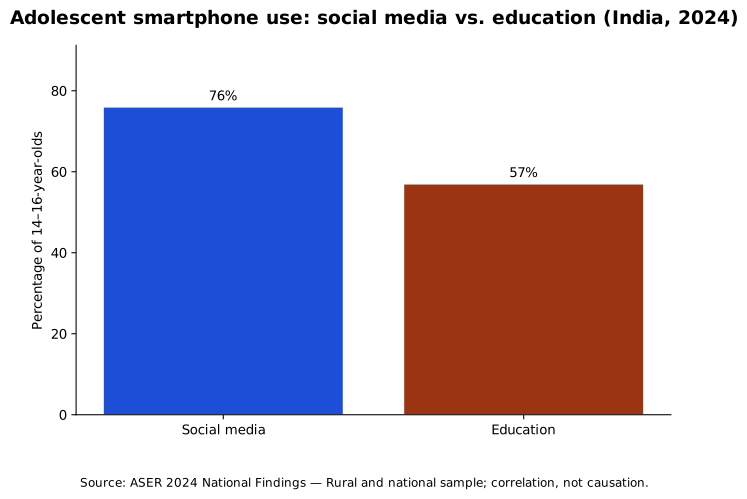
Source: ASER 2024 National Findings; rural and national sample of 14–16-year-olds; correlation, not causation.
A Gap in Use, Not Access
The student pattern is a sharper version of a national one. The NCAER India Human Development Survey Wave 3, a nationally representative survey of more than 212,000 respondents, found that 66% of reported internet use is for entertainment, while 16.1% is for education — a ratio of roughly 4:1.
Point C3 The broader Indian internet-use mix is roughly 4:1 entertainment to education, suggesting that the student pattern reflects a national default rather than an adolescent quirk.
This is not a technology problem. The devices, data plans, and app stores are the same across users. The gap is one of defaults: what opens first, what autoplays next, what notification pulls a user back in. A teenager trying to study on the same phone that hosts Instagram, YouTube, and a dozen games is not weak-willed; they are outnumbered by engineers optimizing for time on app.
The Hours Add Up
The time involved is not trivial. Indian and global estimates place adolescent and young-adult screen time at several hours per day, with a majority exceeding the two-hour recommendation. A rural school study in Pune found that 83% of secondary students exceeded the recommended two hours per day, and mobile phones were the most common device.
Point C4 Heavy daily screen time is common among Indian youth: one Indian review reports 4–5 hours per day for adolescents, and a rural school study found 83% of secondary students exceeded the two-hour recommendation.
Parent-reported data add another layer. A LocalCircles survey of more than 57,000 urban parents found that 49% of children aged 9–17 spend three or more hours per day on social media, videos/OTT, and online games.
Point C5 A LocalCircles survey of urban parents (n=57,000+) found that 49% of children aged 9–17 spend 3+ hours per day on social media, videos/OTT, and online games.
These figures are not directly comparable — they measure different ages, regions, and activities — but they point in the same direction. For millions of students, the screen is a major daily habitat.
The Cost in Sleep, Mood, and Attention
The NCERT mental-health survey of 2022, which collected responses from roughly 379,000 students across classes 6 to 12, found that 81% felt anxious about studies, exams, and results, and 43% reported mood swings. The survey was conducted before the latest surge in short-form video use, but it captures the academic and emotional pressure within which screens now operate.
Point C6 NCERT’s 2022 survey of roughly 379,000 students found 81% anxious about studies/exams and 43% reporting mood swings, showing the pressure context in which student screen use happens.
Against that backdrop, the design of the phone becomes more consequential. Night-time scrolling displaces sleep. Notifications fragment study sessions. The variable rewards of likes, shares, and infinite feeds train attention toward immediate feedback and away from delayed gratification.
A rural secondary-school study found a significant association between excess screen time and delayed bedtime. A systematic review of Indian adolescent social-media use links higher use with higher rates of depression, anxiety, and stress, especially when use is passive or comparison-driven. The causal arrow is debated — anxious students may also scroll more — but the correlation is consistent enough to treat screen habits as part of the student mental-health puzzle.
Point C7 Excessive screen time and night-time device use are associated with poorer sleep, concentration, and mental-health symptoms in Indian adolescents, though causality is not established.
Why the Device Keeps Winning
The attention economy does not hate education. It is simply indifferent to it. A learning app that helps a student master a concept in twenty minutes and then close the app is a poor business for an advertising model that profits from time spent. The result is a landscape where educational content exists, but it competes against products engineered to maximize engagement.
Autoplay, push notifications, red dots, streaks, and algorithmic recommendations are not accidents. They are design choices that make the next swipe easier than the next page of notes. The same teenager who struggles to finish a textbook chapter can scroll through hundreds of short videos in an hour because the interface was built to remove friction at exactly the moment willpower is weakest.
This is not about blaming students. It is about recognizing the asymmetry: one side has behavioral labs, recommendation engines, and revenue targets; the other side has a teenager with homework and a notification badge.
What Would Shift the Default
If the problem is defaults, the response has to be about changing them. Some directions are already visible.
Schools can teach digital literacy as a practical skill: not just how to use a phone, but how to protect attention — turning off notifications during study hours, using airplane mode, separating entertainment and learning apps, and planning screen time rather than reacting to it.
Parents can mediate. Global evidence and Indian parent surveys both suggest that clear rules, device-free meals, and co-viewing or discussion of online content reduce problematic use. The LocalCircles data show that parents are aware of the issue; the gap is often in consistent practice.
Platforms and policymakers have a role that goes beyond warnings. Friction design — prompts to pause, chronological feeds, disabling autoplay for minors, and age-appropriate defaults — can make entertainment less automatic without banning it. The DPDP Rules, 2025 on parental consent for under-18 users are one step; the larger question is whether design incentives can be shifted toward time well spent.
Point C8 The same device and connectivity could support learning if defaults change — through school-led digital literacy, parental mediation, and design friction that makes educational use easier to start and entertainment easier to pause.
Sources and Method
This article draws on ASER 2024 (education and smartphone-use survey), NCERT’s 2022 Mental Health and Well-being of School Students survey, the NCAER India Human Development Survey Wave 3, the FICCI-EY Media & Entertainment Report 2026, a peer-reviewed rural school screen-time study (PMC), and a LocalCircles parent survey. Figures are cited with their scope and confidence where possible; causal claims are avoided where the underlying evidence is correlational.
Open Questions
- How much of the education-versus-entertainment gap is driven by platform design, and how much by lack of engaging educational content in Indian languages?
- Does the ASER social-media/education gap widen or narrow when time, rather than weekly use, is measured?
- Which school or household interventions reliably reduce problematic screen time without making technology the enemy?
- Can educational apps be designed to be as sticky as entertainment feeds, or is the business model the real constraint?
- How should policymakers balance access for learning against the risks of unfettered youth access to addictive feeds?
Related in This Series
- The Attention Extraction — the overview and thesis of the diagnosis.
- By the Numbers: What Indians Actually Do Online — the national digital time budget that sits behind the student pattern.
- The Generational Bet — why the attention economy matters for India’s AI opportunity.
- The Substance Builder — individual practice for turning dead time into small acts of creation.
- Designing for Substance — systemic design choices that could make substance the easier path.
- Attention, Substance, and the AI Moment — the series guide and reading paths.
Article guideImportant points and sources8 pointsShow guideHide guide
- C001core · medium-high · verifiedThe smartphone has become the default study tool and entertainment console for Indian teenagers, but platform design and social incentives tilt daily use toward entertainment and social media, widening the gap between access to learning and actual learning.
- C002core · high · verifiedASER 2024 reports that among 14–16-year-olds who can use a smartphone, 76% used it for social media in the reference week while 57% used it for education.
- C003landscape · high · verifiedThe broader Indian internet-use mix is roughly 4:1 entertainment to education, suggesting that the student pattern reflects a national default rather than an adolescent quirk.
- C004landscape · medium · verifiedHeavy daily screen time is common among Indian youth: one Indian review reports 4–5 hours per day for adolescents, and a rural school study found 83% of secondary students exceeded the two-hour recommendation.
- C005landscape · medium-high · verifiedA LocalCircles survey of urban parents (n=57,000+) found that 49% of children aged 9–17 spend 3+ hours per day on social media, videos/OTT, and online games.
- C006core · high · verifiedNCERT's 2022 survey of roughly 379,000 students found 81% anxious about studies/exams and 43% reporting mood swings, showing the pressure context in which student screen use happens.
- C007core · medium-high · verifiedExcessive screen time and night-time device use are associated with poorer sleep, concentration, and mental-health symptoms in Indian adolescents, though causality is not established.
- C008framing · medium · verifiedThe same device and connectivity could support learning if defaults change — through school-led digital literacy, parental mediation, and design friction that makes educational use easier to start and entertainment easier to pause.
SourcesSources used10 sourcesShow sourcesHide sources
- ASER 2024 National Findingsresearch-report
- NCERT: Mental Health and Well-being of School Students – A Survey, 2022government-report
- NCAER: The Evolving Landscape of Digital Inclusion in India (IHDS Wave 3)research-report
- EY: India’s media and entertainment sector grew 9% to INR2.78 trillion in 2025industry-report
- PMC: Prevalence of excess screen time among secondary school children in rural Indiapeer-reviewed-study
- LocalCircles: 1 in 2 parents have children addicted to social media, OTT & gamingsurvey
- U.S. International Trade Administration: India Digital Economygovernment-report
- International Journal of Indian Psychology: Impact of Digital Screen Time on Adolescentspeer-reviewed-study
- PMC: Social media and mental health among Indian adolescentspeer-reviewed-study
- PIB: Economic Survey 2025-26 — Public Health, Digital Addiction and Mental Health (Release ID 2219931, 29 Jan 2026)government-press-release
Look closer
Sources and notes
Open detailsClose details
Look closer
Sources and notes
These notes collect the sources, counterpoints, and review status behind the article's important points. Read the essay first; open this when you want to check something.
Confidence reflects how strongly the sources support the point (low / medium / high). Status describes the point's role (e.g., core, argument, landscape). Sources link to supporting material;counterpoints note boundary conditions or conflicting findings.
The smartphone has become the default study tool and entertainment console for Indian teenagers, but platform design and social incentives tilt daily use toward entertainment and social media, widening the gap between access to learning and actual learning.
verifiedreviewed 2026-07-18
- Sources (2)
“Among 14–16-year-olds who can use a smartphone, 76% used it for social media in the reference week while 57% used it for education.”
ASER 2024 National Findingsdirect“NCERT's 2022 survey of roughly 379,000 students found 81% anxious about studies/exams and 43% reporting mood swings.”
NCERT: Mental Health and Well-being of School Students – A Survey, 2022indirect
- Counterpoints (1)
Many students use the same platforms and devices for peer learning, exam groups, and informal skill discovery, so the boundary between educational and social use is fuzzy.
ASER 2024 reports that among 14–16-year-olds who can use a smartphone, 76% used it for social media in the reference week while 57% used it for education.
verifiedreviewed 2026-07-18
- Sources (1)
“Of those who know how to use a smartphone, 57% reported using it for an educational activity in the preceding week while 76% said they used it for social media during the same period.”
ASER 2024 National Findingsdirect
- Counterpoints (1)
The survey measures any use during the reference week, not time spent or learning outcomes, and the same session can include both social and educational content.
The broader Indian internet-use mix is roughly 4:1 entertainment to education, suggesting that the student pattern reflects a national default rather than an adolescent quirk.
verifiedreviewed 2026-07-18
- Sources (1)
“NCAER IHDS Wave 3 finds 66% of reported internet use is for entertainment and 16.1% is for education, a ratio of about 4.1:1.”
NCAER: The Evolving Landscape of Digital Inclusion in India (IHDS Wave 3)direct
- Counterpoints (1)
Reported shares depend on self-classification and may not map cleanly onto actual minutes; multi-purpose use can be classified differently.
Heavy daily screen time is common among Indian youth: one Indian review reports 4–5 hours per day for adolescents, and a rural school study found 83% of secondary students exceeded the two-hour recommendation.
verifiedreviewed 2026-07-18
- Sources (2)
“A review of Indian adolescent screen-time studies reports averages of 4–5 hours per day across devices and activities.”
International Journal of Indian Psychology: Impact of Digital Screen Time on Adolescentsdirect“A rural secondary-school study in Pune found 83.2% of students spent more than the recommended two hours per day on screen devices; mobile phones were the most common device.”
PMC: Prevalence of excess screen time among secondary school children in rural Indiadirect
- Counterpoints (1)
Screen-time figures vary by age, region, income, and measurement method; no single nationally representative census exists.
A LocalCircles survey of urban parents (n=57,000+) found that 49% of children aged 9–17 spend 3+ hours per day on social media, videos/OTT, and online games.
verifiedreviewed 2026-07-18
- Sources (1)
“49% of urban Indian parents of children aged 9–17 say their children spend an average of 3 hours or more each day on social media, videos/OTT, and online games.”
LocalCircles: 1 in 2 parents have children addicted to social media, OTT & gamingdirect
- Counterpoints (1)
The survey is self-reported by parents, urban-skewed, and measures perceived time rather than platform-measured time.
NCERT's 2022 survey of roughly 379,000 students found 81% anxious about studies/exams and 43% reporting mood swings, showing the pressure context in which student screen use happens.
verifiedreviewed 2026-07-18
- Sources (1)
“A large percentage of students (81%) experienced anxiety over coursework, examinations, and results; 43% had mood swings.”
NCERT: Mental Health and Well-being of School Students – A Survey, 2022direct
- Counterpoints (1)
The survey captures self-reported emotional states, not clinical diagnoses, and was conducted before the most recent surge in short-form video use.
Excessive screen time and night-time device use are associated with poorer sleep, concentration, and mental-health symptoms in Indian adolescents, though causality is not established.
verifiedreviewed 2026-07-18
- Sources (3)
“Excess screen time was significantly associated with delayed bedtime on weekdays and weekends.”
PMC: Prevalence of excess screen time among secondary school children in rural Indiadirect“Large student survey documents widespread anxiety and mood swings, the emotional context in which screen habits are embedded.”
NCERT: Mental Health and Well-being of School Students – A Survey, 2022indirect“A systematic review of Indian adolescent social-media use links higher use with higher rates of depression, anxiety, and stress, especially when use is passive or comparison-driven.”
PMC: Social media and mental health among Indian adolescentsdirect
- Counterpoints (1)
Most available studies are cross-sectional; causality and reverse causation remain unresolved.
The same device and connectivity could support learning if defaults change — through school-led digital literacy, parental mediation, and design friction that makes educational use easier to start and entertainment easier to pause.
verifiedreviewed 2026-07-18
- Sources (2)
“The high share of education-related smartphone use (57%) shows that learning-oriented use is already common and could be expanded with better defaults.”
ASER 2024 National Findingsindirect“Parent surveys indicate awareness of problematic use and support for rules such as parental consent and time limits.”
LocalCircles: 1 in 2 parents have children addicted to social media, OTT & gamingindirect
- Counterpoints (1)
Evidence on which specific interventions work at scale in India is limited; global findings may not transfer directly.
Review recordHow this was madeShow detailsHide details
Created 2026-07-05 by human. Policy: policy:default v1.0.0.
Researched, drafted, and structured with AI agents; approved for publication by a human reviewer.
✓ Approved hash matches current article
Reviews
- humanapproved2026-07-05
Scope: thesis, claims, tone, privacy, sources
contentHash:
ef94b4d3b4278ba5…Human author approved publication.
- humanapproved2026-07-18
Scope: article
contentHash:
9625101fc0860966…Re-approved by maintainer after the meta#61 P2 series migration (hardcoded kicker strip + arc reorder; no prose change beyond the kicker line; issue #124 instruction).
Machine-readable files
The same points, sources, and relationships are also available as structured files for agents and tools. The JSON follows thepublication record schema.