India’s national mental-health helpline, Tele-MANAS, was launched in 2022 to give anyone a free, anonymous phone line to a trained counselor. A few years later, as of March 2026, it had handled more than 34 lakh calls. Roughly seven in ten of those calls came from people aged 18 to 45. Those numbers do not prove that smartphones are making India anxious. They do show that distress is common, that young adults are the most likely to reach out, and that the country’s existing mental-health infrastructure is being measured against a demand far larger than it was built for.
Point C1 As of March 2026, Tele-MANAS had handled more than 34 lakh calls, with roughly 70% of callers aged 18–45.
The Helpline as a Barometer
A helpline is not a census. The people who call are self-selected: they are aware enough to seek help, distressed enough to act, and able to access a phone. Still, 32 lakh calls is a large signal. It suggests that millions of Indians are experiencing anxiety, low mood, sleep trouble, relationship conflict, or academic and work stress severe enough to prompt them to pick up the phone.
The age skew matters. Most callers are young adults, the same cohort that has grown up with cheap data, cheap smartphones, and feed-based platforms. That overlap is not enough to establish causation, but it is enough to ask whether the design of their daily attention environment is adding load to lives that already carry education, employment, and social pressures.
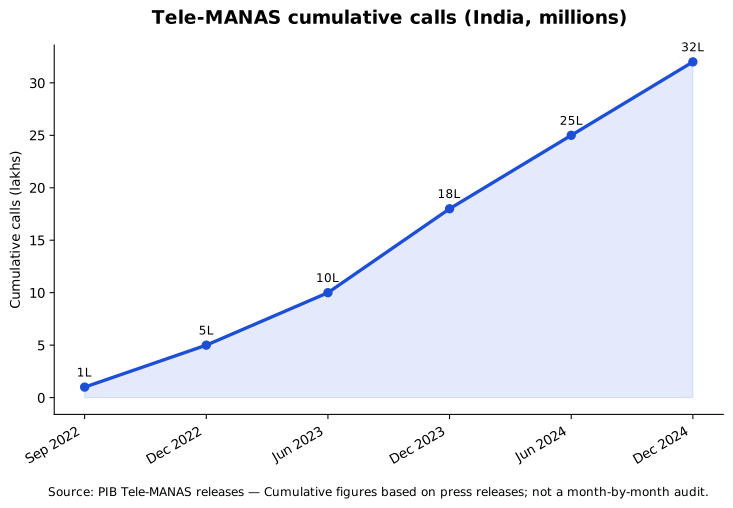 Tele-MANAS cumulative call volumes show a national mental-health signal concentrated among young adults. Source: PIB press release on Tele-MANAS call completion.
What the School Surveys Show
Tele-MANAS captures people who have crossed a threshold of distress. School-based surveys capture the mood of adolescents before that threshold. The NCERT Mental Health and Well-being of School Students Survey, conducted in 2022 with more than 3.5 lakh students, found high levels of anxiety, mood disturbance, and sleep problems. State-level surveys have reported similar patterns, with significant shares of adolescents saying they feel anxious, have trouble concentrating, or do not get enough restful sleep.
Point C2 NCERT and state surveys report high rates of anxiety, mood disturbance, and sleep problems among Indian adolescents.
These findings are not limited to privileged, urban teenagers. The expansion of affordable smartphones and mobile data has made the same attention economy felt in small towns and rural areas, often with fewer offline supports. The survey data should not be read as a precise diagnosis of a generation, but it is consistent with what helpline data, clinical reports, and parent-teacher observations are saying: many young Indians are carrying a psychological load that looks heavier than the one their parents described at the same age.
Sleep, Screens, and the Next-Day Cost
One of the clearest documented pathways between heavy evening screen use and next-day difficulty is sleep. Multiple reviews and studies find that screen use before bed delays melatonin, shortens sleep duration, and fragments sleep quality. The mechanism is partly the blue light emitted by displays, but it is also behavioral: an infinite feed does not come with a natural stopping point, and a notification at 11 p.m. can restart a session that was supposed to end at 10.
Point C3 Sleep disruption from evening screen use is one documented pathway between heavy smartphone use and next-day distress.
Sleep loss is not just about feeling tired. It predicts irritability, reduced impulse control, poorer working memory, and lower thresholds for anxiety the following day. For a student preparing for exams, or a young worker navigating a new job, a week of shortened sleep can turn ordinary stress into something that feels overwhelming. The screen is not the only cause of poor sleep, academic pressure, heat, noise, and family routines all matter, but it is a modifiable one, which makes it a useful place to intervene.
From Signal to Response
The Tele-MANAS and school-survey data can be read in two ways. One reading is moral: young people are weak, addicted, or poorly raised. The other reading is public health: a large population is showing signs of strain, and the environment in which they live, study, work, and sleep is one of the inputs.
Point C4 Mental-health data should be read as a public-health signal shaped by design, economics, and social context, not as evidence of individual weakness.
The public-health reading is more useful. It moves the conversation from blame to systems. It asks whether platforms could reduce nighttime notifications by default. Whether schools could teach sleep and attention literacy, not just screen-time bans. Whether families could agree on device curfews without framing them as punishment. Whether policymakers could fund more counselors and better integrate mental-health support into primary care.
None of those changes require demonizing technology. A phone can be a lifeline, a tutor, and a source of connection. The goal is to reduce the design-driven pressure that keeps people awake, anxious, and scrolling past the point they intended.
Sources and Method
This article draws on a government press release about Tele-MANAS call volumes, the NCERT Mental Health and Well-being of School Students Survey, and peer-reviewed research on screen time and sleep in adolescents. It also uses the WHO fact sheet on adolescent mental health as a global comparator. The argument stays correlational: the evidence links screen-heavy routines, sleep disruption, and anxiety, but it does not establish a single causal chain for any individual. The article treats the data as a public-health signal rather than a diagnosis.
Related in This Series
- The Attention Extraction — the overview and thesis of the diagnosis.
- By the Numbers: What Indians Actually Do Online — how India’s digital time budget is spent across entertainment, education, work, and communication.
- The Student Screen — how adolescents split their screen time between education and entertainment.
- Attention, Substance, and the AI Moment — the full series guide and reading paths.
Article guideImportant points and sources4 pointsShow guideHide guide
- C001core · high · verifiedAs of March 2026, Tele-MANAS had handled more than 34 lakh calls, with roughly 70% of callers aged 18–45.
- C002core · high · verifiedNCERT and state surveys report high rates of anxiety, mood disturbance, and sleep problems among Indian adolescents.
- C003landscape · medium-high · verifiedSleep disruption from evening screen use is one documented pathway between heavy smartphone use and next-day distress.
- C004argument · medium · verifiedMental-health data should be read as a public-health signal shaped by design, economics, and social context, not as evidence of individual weakness.
SourcesSources used5 sourcesShow sourcesHide sources
- MoHFW: Rajya Sabha Unstarred Question No. 2806 — Youth Mental Health Crisis (answered 17 March 2026)government-report
- NCERT: Mental Health and Well-being of School Students Surveygovernment-report
- Xiao et al.: When Screens Replace Sleep: Short Video Addiction Impairs Executive Function Through Sleep Disruption in Youth (Brain and Behavior, 2026)peer-reviewed-study
- WHO: Adolescent mental health fact sheetgovernment-report
- PIB: Economic Survey 2025-26 — Public Health, Digital Addiction and Mental Health (Release ID 2219931, 29 Jan 2026)report
Look closer
Sources and notes
Open detailsClose details
Look closer
Sources and notes
These notes collect the sources, counterpoints, and review status behind the article's important points. Read the essay first; open this when you want to check something.
Confidence reflects how strongly the sources support the point (low / medium / high). Status describes the point's role (e.g., core, argument, landscape). Sources link to supporting material;counterpoints note boundary conditions or conflicting findings.
As of March 2026, Tele-MANAS had handled more than 34 lakh calls, with roughly 70% of callers aged 18–45.
verifiedreviewed 2026-07-18
- Sources (2)
“As on 12.03.2026, 36 States/UTs have set up 53 Tele MANAS Cells and have started tele mental health services. More than 34.34 lakh calls have been handled on the helpline number; about 7% of callers were aged 13-17 years and 70% in the 18-45 years age range.”
MoHFW: Rajya Sabha Unstarred Question No. 2806 — Youth Mental Health Crisis (answered 17 March 2026)direct“Tele-MANAS, launched by the MoHFW in October 2022, offers a 24/7 toll-free mental health helpline (14416) across all states and UTs; the service has received over 32 lakh calls since its launch, reflecting its relevance and impact.”
PIB: Economic Survey 2025-26 — Public Health, Digital Addiction and Mental Health (Release ID 2219931, 29 Jan 2026)indirect
- Counterpoints (1)
Helpline callers are self-selected and may not represent the wider population; some calls may be for information rather than clinical distress.
NCERT and state surveys report high rates of anxiety, mood disturbance, and sleep problems among Indian adolescents.
verifiedreviewed 2026-07-18
- Sources (2)
“Frequent mood swings along with feeling anxious about studies, examinations and results were reported widely among students; changes in sleeping pattern were reported by 39%.”
NCERT: Mental Health and Well-being of School Students Surveydirect“WHO notes that adolescence is a critical period for mental health, with anxiety and depression among the leading causes of illness and disability in adolescents globally.”
WHO: Adolescent mental health fact sheetbackground
- Counterpoints (1)
Survey responses are self-reported and subject to social-desirability and interpretation bias; reported rates vary by region, age, and survey instrument.
Sleep disruption from evening screen use is one documented pathway between heavy smartphone use and next-day distress.
verifiedreviewed 2026-07-18
- Sources (1)
“Short video addiction was negatively associated with sleep quality, physical activity, and executive function; sleep quality was a significant partial mediator in the addiction–executive-function relationship.”
Xiao et al.: When Screens Replace Sleep: Short Video Addiction Impairs Executive Function Through Sleep Disruption in Youth (Brain and Behavior, 2026)direct
- Counterpoints (1)
Not all screen content has the same effect; some digital interventions can improve sleep and mental health, and causality is complicated by confounders such as stress and schedule demands.
Mental-health data should be read as a public-health signal shaped by design, economics, and social context, not as evidence of individual weakness.
verifiedreviewed 2026-07-18
- Sources (2)
“The scale of Tele-MANAS call volume suggests a population-level pattern of distress rather than isolated individual cases.”
MoHFW: Rajya Sabha Unstarred Question No. 2806 — Youth Mental Health Crisis (answered 17 March 2026)indirect“Frequent mood swings along with feeling anxious about studies, examinations and results were reported widely among students; changes in sleeping pattern were reported by 39%.”
NCERT: Mental Health and Well-being of School Students Surveyindirect
- Counterpoints (1)
Individual choices, family environment, academic pressure, and economic insecurity are also major contributors; framing everything as design can understate personal and social agency.
Review recordHow this was madeShow detailsHide details
Created 2026-07-05 by human. Policy: policy:default v1.0.0.
✓ Approved hash matches current article
Reviews
- humanapproved2026-07-05
Scope: thesis, claims, tone, privacy, sources
contentHash:
e8ccd9151baf4e02…Human author approved publication.
- humanapproved2026-07-17
Scope: article
contentHash:
f8a2d65f399946e6…Re-approved by maintainer after the meta#61 P1 citation repairs (publish instruction, 2026-07-17).
- humanapproved2026-07-18
Scope: article
contentHash:
71cb1a8cfc23de56…Re-approved by maintainer after the meta#61 P2 series migration (hardcoded kicker strip + arc reorder; no prose change beyond the kicker line; issue #124 instruction).
Machine-readable files
The same points, sources, and relationships are also available as structured files for agents and tools. The JSON follows thepublication record schema.