India’s internet users spend roughly 1.1 trillion hours on smartphones each year. That attention is not free. It is sold, mostly to advertisers, and the proceeds are booked by a small number of platforms. The question is who profits from the sale.
The short answer is sobering. Two foreign-owned platforms, Google and Meta, captured about 64% of India’s digital advertising revenue in 2025. Their India entities reported tens of thousands of crores in gross advertising sales, but most of that money leaves the country as payments to global parent companies. Meanwhile, the creators whose content supplies those platforms operate in a winner-take-most market: millions post, only a small fraction earn a sustainable income, and the top sliver takes the largest share.
Point C1 Google and Meta captured roughly 64% of India’s ₹94,700 crore digital advertising market in 2025, according to the FICCI-EY Media & Entertainment Report 2026, leaving the domestic platform ecosystem with a minority share of the revenue generated from Indian attention.
The Platform Tax
India’s digital advertising market grew roughly 26% in 2025 to reach ₹94,700 crore, per FICCI-EY. Search and social platforms — almost entirely Google and Meta — accounted for 64% of that total. The next-largest category, e-commerce and point-of-sale advertising, reached about ₹22,000 crore, or 23% of the market, spread across Amazon, Flipkart, Zomato, Zepto, Blinkit, Nykaa, Myntra, and others.
The concentration matters because it shapes what gets built. Advertisers follow audience attention, and audience attention in India is concentrated in a handful of foreign-owned apps: YouTube, Instagram, Facebook, and WhatsApp. Domestic platforms compete for the remaining share, and new entrants face the classic platform problem: users are where users already are.
Point C2 Meta India’s gross advertising revenue reached ₹22,730 crore in FY24, while Google India’s gross advertising revenue reached ₹34,742 crore in FY25, putting the two firms’ combined India gross ad sales at roughly ₹57,500 crore in the latest available filings.
The numbers come with a caveat. Google and Meta India do not fully separate India revenue in their global investor filings. The figures above are from their Indian operating entities’ Registrar of Companies (ROC) filings, as reported by business publications citing Tofler. They capture the portion of Indian advertising business billed through local subsidiaries, not necessarily every rupee spent by Indian advertisers on the platforms.
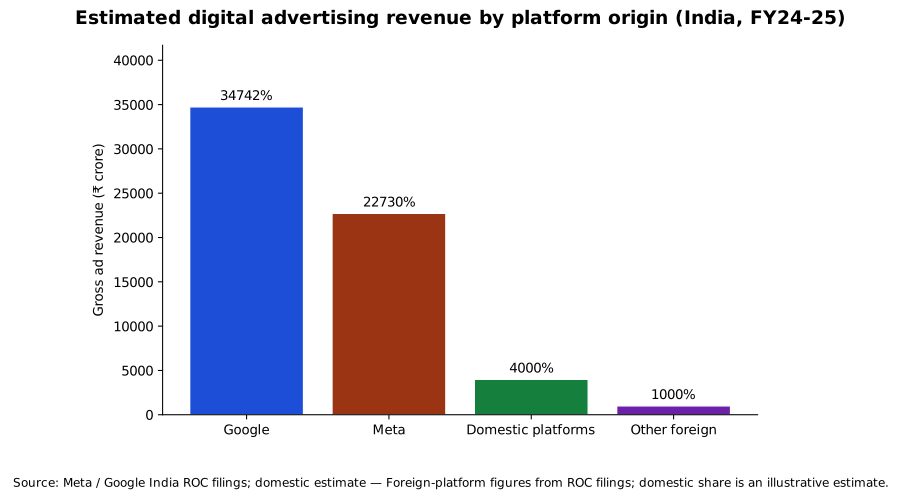
Source: Meta and Google India ROC filings; domestic share is an illustrative estimate. Figures are gross advertising revenue before inter-company costs.
Gross Revenue vs. What Stays
A headline figure of ₹57,500 crore does not mean ₹57,500 crore stayed in India. Google India and Meta India operate partly as advertising resellers. They book gross revenue from Indian advertisers, then remit most of it to parent entities abroad as cost of inventory or advertising space.
Google India’s FY25 filings illustrate the pattern. Gross advertising revenue was ₹34,742 crore, but the company paid ₹32,047.6 crore to Google Asia Pacific for advertising inventory. Net advertising revenue in India was therefore ₹2,694.4 crore, down 2% year-on-year despite double-digit gross growth. Total revenue from operations was ₹5,340.1 crore, and net profit was about ₹1,437 crore.
Point C3 Because Google and Meta India operate as advertising resellers, most of the gross ad revenue they report flows back to global parent entities as inter-company costs, so the net economic benefit retained in India is far smaller than the headline sales figure suggests.
This is not illegal tax evasion; it is the ordinary structure of multinational digital advertising. But it does mean that the value created from Indian attention — the eyeballs, the data, the content, the language markets — is largely captured outside India. Domestic rivals such as JioStar are beginning to compete at comparable revenue scale, but the search-and-social duopoly remains the default destination for most ad budgets.
The Creator Precariat
Platforms need content, and India’s creator economy supplies it in abundance. A 2025 Boston Consulting Group report, From Content to Commerce: Mapping India’s Creator Economy, estimates that India has 2–2.5 million active digital creators — defined broadly as people with more than 1,000 followers who publish content regularly.
Only a small slice of that base earns reliably. The same BCG report finds that 8–10% of active creators monetize effectively. The rest earn little or nothing. Business Today, summarizing the report, notes that a majority of creators earn less than ₹18,000 per month, and smaller YouTubers average about ₹3.8 lakh per year. A creator with a million-plus subscribers and strong brand deals can cross ₹50,000 per month, but that tier is rare.
Point C4 India has an estimated 2–2.5 million active digital creators, but only 8–10% monetize effectively, and most earn less than a living wage from content creation.
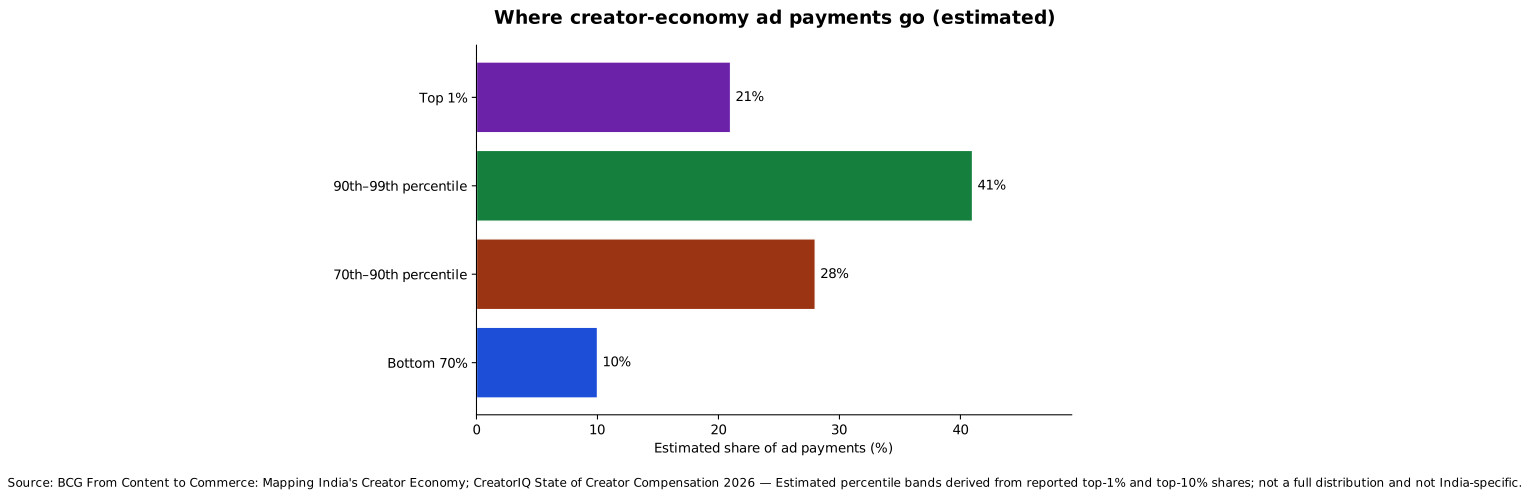
Source: BCG From Content to Commerce: Mapping India’s Creator Economy and CreatorIQ State of Creator Compensation 2026; bands are illustrative estimates based on reported top-1% and top-10% shares.
The income inequality is sharp even among those who do earn. While the BCG report does not publish a full Lorenz curve, global industry data from CreatorIQ’s 2026 State of Creator Compensation report shows the top 10% of creators earning 62% of total creator payments, and the top 1% earning 21%. India’s lower per-view ad rates and smaller brand budgets suggest the concentration is at least as pronounced domestically. YouTube CPMs in India are estimated to be a fraction of those in the United States, which compresses ad-sharing income for everyone below the top tier.
The Illusion of the Gold Rush
The creator economy is often framed as a path to independence: make videos, build an audience, quit your job. For some it works. For most, the arithmetic is harsher.
India’s creators influence an estimated $350–400 billion in annual consumer spending, projected to exceed $1 trillion by 2030, according to BCG. Yet the ecosystem’s direct revenue is only $20–25 billion today. The bulk of the economic value is captured by brands, platforms, and e-commerce transactions, not by the people who produce the content that drives the funnel.
Point C5 Creator income is highly concentrated, with the largest share of payments going to a small top tier; most creators depend on brand deals and ad revenue in a market where per-view rates are low and unpredictable.
This concentration is not a market failure in the narrow sense. It is how attention markets tend to work when distribution is controlled by a few platforms and rewards are allocated by algorithmic reach. But the result is a false-hope funnel: millions invest time and attention in building an audience, while the platforms capture the advertising margin and the top percentile captures most of the creator payouts.
What the Money Could Buy
The policy implication is not to ban foreign platforms or blame creators. It is to ask what a more balanced attention economy would look like.
If even a modest share of the ₹94,700 crore digital advertising market flowed toward domestic platforms that invested in Indian-language safety, educational content, local journalism, and civic tools, the composition of the internet could shift. If creator pay were more transparent and less dependent on opaque algorithmic distribution, more people could treat content creation as a sustainable craft rather than a lottery.
Point C6 The current structure creates an extraction dynamic: advertising value generated from Indian attention disproportionately benefits foreign platforms and a small top tier of creators, while domestic platforms and mid-tier creators operate on thinner margins.
The counterargument deserves a fair hearing. Foreign platforms have built world-class infrastructure, expanded access to small businesses, and given Indian creators global reach. Meta reports that 92% of its advertisers in India are small and medium enterprises. Google Search and YouTube are genuinely useful. The issue is not their existence but the absence of a credible domestic alternative and the imbalance in value capture.
Sources and Method
This article draws on four kinds of sources:
- Regulatory filings: Google India and Meta India gross advertising revenue figures from Registrar of Companies filings, as reported by Angel One, PitchOnNet, and Business Today via Tofler.
- Industry reports: FICCI-EY Media & Entertainment Report 2026 for total digital advertising market size and platform share; BCG’s From Content to Commerce: Mapping India’s Creator Economy for creator counts, monetization rates, and consumer-spending influence.
- Business journalism: Storyboard18, Business Today, and PitchOnNet summaries of the FICCI-EY and BCG reports.
- Global comparison: CreatorIQ State of Creator Compensation 2026 for creator-income concentration; labeled as a global benchmark applied to India.
All monetary figures are in Indian rupees unless otherwise noted. “Gross advertising revenue” refers to the total value of ad inventory sold before inter-company costs; “net advertising revenue” is what the India entity retains after paying parent entities for inventory. The distinction is important: gross revenue overstates the domestic economic benefit.
Open Questions
- How much of Google and Meta’s India gross ad revenue reflects spending by Indian advertisers versus exports of ad inventory sold to global buyers targeting Indian users?
- What share of creator income in India comes from platform ad-sharing versus brand deals, affiliate links, live commerce, and virtual gifting?
- Could domestic platforms such as JioStar, ShareChat, or Dailyhunt capture a larger share of digital ad spend, and what would they need to offer advertisers?
- Would greater transparency in platform payouts reduce income concentration among creators, or would algorithmic reach still favor the top tier?
- How should policymakers treat the difference between gross revenue, net revenue, and profit retained in India when designing digital-economy regulation?
Related in This Series
- The Attention Extraction — the overview and thesis of the diagnosis.
- By the Numbers: What Indians Actually Do Online — how India’s digital time budget is allocated across activities.
- The Generational Bet — what India risks missing if the attention economy keeps winning.
- The Substance Builder — individual practice: turning dead time into small acts of creation.
- Designing for Substance — systemic design: platform incentives and the attention economy.
- Attention, Substance, and the AI Moment: A Series Index — the full series guide.
Article guideImportant points and sources6 pointsShow guideHide guide
- C001core · high · verifiedGoogle and Meta captured roughly 64% of India's ₹94,700 crore digital advertising market in 2025, leaving the domestic platform ecosystem with a minority share of the revenue generated from Indian attention.
- C002core · high · verifiedMeta India's gross advertising revenue reached ₹22,730 crore in FY24, while Google India's gross advertising revenue reached ₹34,742 crore in FY25, putting the two firms' combined India gross ad sales at roughly ₹57,500 crore in the latest available filings.
- C003core · high · verifiedBecause Google and Meta India operate as advertising resellers, most of the gross ad revenue they report flows back to global parent entities as inter-company costs, so the net economic benefit retained in India is far smaller than the headline sales figure suggests.
- C004core · high · verifiedIndia has an estimated 2–2.5 million active digital creators, but only 8–10% monetize effectively, and most earn less than a living wage from content creation.
- C005landscape · medium-high · verifiedCreator income is highly concentrated, with the largest share of payments going to a small top tier; most creators depend on brand deals and ad revenue in a market where per-view rates are low and unpredictable.
- C006framing · medium-high · verifiedThe current structure creates an extraction dynamic: advertising value generated from Indian attention disproportionately benefits foreign platforms and a small top tier of creators, while domestic platforms and mid-tier creators operate on thinner margins.
SourcesSources used8 sourcesShow sourcesHide sources
- Storyboard18: Google and Meta hold 64% of India's digital ad marketnews-report
- FICCI-EY Media & Entertainment Report 2026 (cited via Storyboard18)industry-report
- Angel One: Google India Gross Ads Revenue Rises 11% in FY25news-report
- PitchOnNet: Meta India gross advertising revenue reached ₹22,730 crore in FY24news-report
- PitchOnNet: JioStar emerges as India's challenger to Google and Meta in the revenue racenews-report
- BCG: From Content to Commerce: Mapping India's Creator Economyresearch-report
- Business Today: BCG report reveals harsh truth about India's creatorsnews-report
- CreatorIQ: State of Creator Compensation 2026industry-report
Look closer
Sources and notes
Open detailsClose details
Look closer
Sources and notes
These notes collect the sources, counterpoints, and review status behind the article's important points. Read the essay first; open this when you want to check something.
Confidence reflects how strongly the sources support the point (low / medium / high). Status describes the point's role (e.g., core, argument, landscape). Sources link to supporting material;counterpoints note boundary conditions or conflicting findings.
Google and Meta captured roughly 64% of India's ₹94,700 crore digital advertising market in 2025, leaving the domestic platform ecosystem with a minority share of the revenue generated from Indian attention.
verifiedreviewed 2026-07-18
- Sources (2)
“Search and social media platforms, led by Google and Meta, claimed 64% of India's total digital advertising revenues in 2025, with digital advertising reaching ₹94,700 crore.”
Storyboard18: Google and Meta hold 64% of India's digital ad marketdirect“FICCI-EY Media & Entertainment Report 2026 estimates India's digital advertising market at ₹94,700 crore in 2025, growing 26% year-on-year.”
FICCI-EY Media & Entertainment Report 2026 (cited via Storyboard18)direct
- Counterpoints (1)
The 64% share is an industry estimate from a trade report and may not exactly match the platforms' internal revenue recognition; e-commerce/retail media is the fastest-growing challenger segment.
Meta India's gross advertising revenue reached ₹22,730 crore in FY24, while Google India's gross advertising revenue reached ₹34,742 crore in FY25, putting the two firms' combined India gross ad sales at roughly ₹57,500 crore in the latest available filings.
verifiedreviewed 2026-07-18
- Sources (2)
“Meta India's gross advertising revenue across Facebook, Instagram, and WhatsApp platforms reached ₹22,730 crore in FY24, rising 24% year-on-year.”
PitchOnNet: Meta India gross advertising revenue reached ₹22,730 crore in FY24direct“Google India's gross advertising revenue rose 11.3% year-on-year to ₹34,742 crore in FY25, compared with ₹31,221 crore in FY24, according to RoC filings.”
Angel One: Google India Gross Ads Revenue Rises 11% in FY25direct
- Counterpoints (1)
The Meta and Google figures are from different fiscal years (FY24 for Meta, FY25 for Google) and may not be directly additive; Meta's FY25 gross figure is expected to be higher when filed.
Because Google and Meta India operate as advertising resellers, most of the gross ad revenue they report flows back to global parent entities as inter-company costs, so the net economic benefit retained in India is far smaller than the headline sales figure suggests.
verifiedreviewed 2026-07-18
- Sources (2)
“Google India paid ₹32,047.6 crore to Google Asia Pacific for advertising inventory in FY25, leaving net advertising revenue at ₹2,694.4 crore and total revenue from operations at ₹5,340.1 crore.”
Angel One: Google India Gross Ads Revenue Rises 11% in FY25direct“Google India and Meta India operate as advertising resellers, recording gross revenues that reflect full ad inventory sold to Indian advertisers before remitting most of that amount back to global parent entities as inter-company costs.”
PitchOnNet: JioStar emerges as India's challenger to Google and Meta in the revenue racedirect
- Counterpoints (1)
The reseller structure is legal and ordinary for multinational platforms; it also supports local employment, SME advertiser access, and creator distribution that would not otherwise exist.
India has an estimated 2–2.5 million active digital creators, but only 8–10% monetize effectively, and most earn less than a living wage from content creation.
verifiedreviewed 2026-07-18
- Sources (2)
“BCG's From Content to Commerce: Mapping India's Creator Economy estimates 2–2.5 million monetized content creators influencing more than $350–400 billion in consumer spending.”
BCG: From Content to Commerce: Mapping India's Creator Economydirect“Only 8–10% of India's 2–2.5 million active creators effectively monetize their content; a majority earn less than ₹18,000 a month and smaller YouTubers average ₹3.8 lakh a year.”
Business Today: BCG report reveals harsh truth about India's creatorsdirect
- Counterpoints (1)
Creator counts and monetization rates depend on definitions; part-time creators may not expect a living wage, and informal income streams are not fully captured.
Creator income is highly concentrated, with the largest share of payments going to a small top tier; most creators depend on brand deals and ad revenue in a market where per-view rates are low and unpredictable.
verifiedreviewed 2026-07-18
- Sources (2)
“Most creators rely on ad revenue and brand sponsorships, which remain skewed in favour of top-tier influencers; those with a million-plus subscribers can cross ₹50,000 a month, but that tier is rare.”
Business Today: BCG report reveals harsh truth about India's creatorsdirect“Global data shows the top 10% of creators earned 62% of total payments in 2025 and the top 1% earned 21%, indicating strong income concentration in creator markets.”
CreatorIQ: State of Creator Compensation 2026indirect
- Counterpoints (1)
The income-concentration percentages are global, not India-specific; India's market structure may differ, and direct India data on creator payment distribution are not publicly available.
The current structure creates an extraction dynamic: advertising value generated from Indian attention disproportionately benefits foreign platforms and a small top tier of creators, while domestic platforms and mid-tier creators operate on thinner margins.
verifiedreviewed 2026-07-18
- Sources (2)
“Google and Meta's 64% share of India's digital ad market underscores the deepening concentration of ad spend on a small number of global platforms.”
Storyboard18: Google and Meta hold 64% of India's digital ad marketdirect“Most Indian creators earn too little or nothing at all, while the ecosystem influences hundreds of billions in consumer spending.”
Business Today: BCG report reveals harsh truth about India's creatorsindirect
- Counterpoints (1)
Foreign platforms also invest in Indian infrastructure, employ local staff, enable SME advertising, and give creators global reach; extraction is a framing, not a measured transfer.
Review recordHow this was madeShow detailsHide details
Created 2026-07-05 by human. Policy: policy:default v1.0.0.
Researched, drafted, and structured with AI agents; approved for publication by a human reviewer.
✓ Approved hash matches current article
Reviews
- humanapproved2026-07-05
Scope: thesis, claims, tone, privacy, sources
contentHash:
442c5c2d56bf1422…Human author approved publication.
- humanapproved2026-07-18
Scope: article
contentHash:
4d84cf9494e9b800…Re-approved by maintainer after the meta#61 P2 series migration (hardcoded kicker strip + arc reorder; no prose change beyond the kicker line; issue #124 instruction).
Machine-readable files
The same points, sources, and relationships are also available as structured files for agents and tools. The JSON follows thepublication record schema.