India’s digital-access story created one of the world’s largest online workforces. The same transition, however, is now showing up inside offices, factories, and remote-work windows as a different kind of problem: people are present but not fully engaged, interrupted before they can finish a thought, and entering the labour market with uneven preparation. The engagement gap is not a separate issue from the attention economy. It is where the attention economy meets gross domestic product.
Point C1 India’s employee engagement fell to 23% in 2025, a seven-point drop from the prior rolling average and the lowest level in four years, and Gallup estimates the annual cost of disengagement at roughly $351 billion, or about 9% of GDP.
The Engagement Number
Gallup’s State of the Global Workplace data place India’s 2025 employee engagement at 23%. That is above the global average of 20% and the South Asia average of 21%, but it is a sharp step back from 33% in 2022 and 30% in 2024. A Gallup analysis calls this the lowest figure in four years and notes that managers saw the steepest decline, falling nine points to 30%.
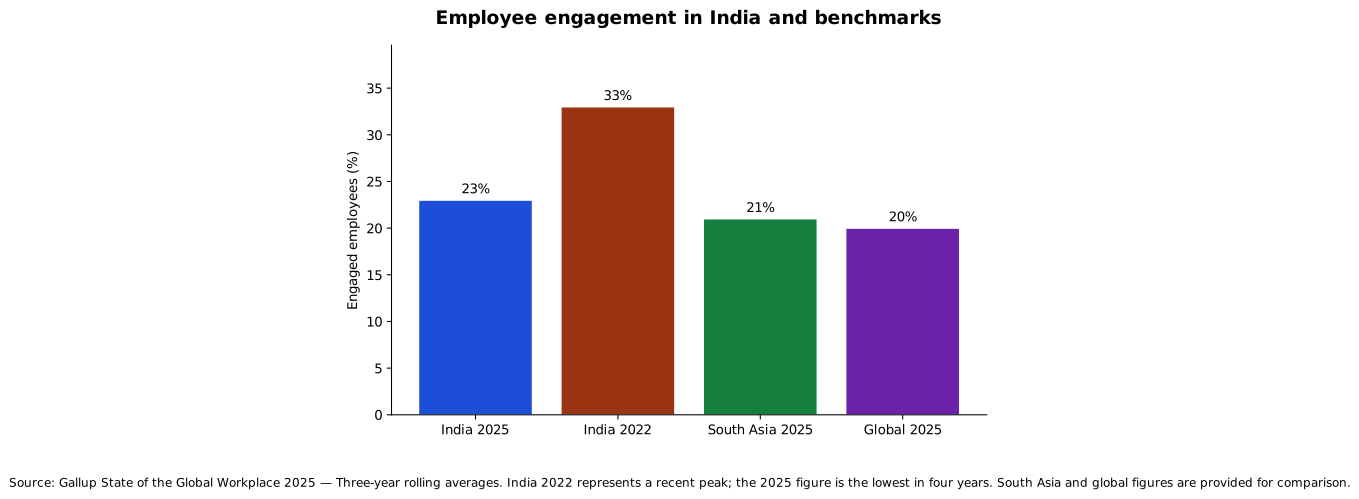
Source: Gallup State of the Global Workplace 2025; three-year rolling averages. India 2022 is shown as a recent peak for comparison.
The same analysis estimates that disengagement costs India roughly $351 billion in lost productivity annually, equal to about 9% of GDP. That figure is an estimate, not a precise national accounting entry, and it reflects more than digital distraction. Engagement is shaped by wages, job quality, management, and macroeconomic conditions. Still, the scale is large enough that even a partial link to attention fragmentation matters.
The Interruption Economy
Engagement is about motivation and meaning. Focus is about whether people can stay with a task long enough to finish it. The two are connected: workers who are interrupted every few minutes rarely reach the state of absorption that strong engagement produces.
Point C2 Knowledge workers in digital environments face an interruption economy characterized by frequent interruptions, long recovery times, and scarce uninterrupted focus windows.
Microsoft’s 2025 Work Trend Index, drawing on Microsoft 365 telemetry and a survey of 31,000 workers, found that employees are interrupted as often as every two minutes during core work hours, or up to 275 times per day. Research by Gloria Mark at UC Irvine has repeatedly found that it takes roughly 23 minutes to return to a task after an interruption. Microsoft’s report also finds that 40% of employees never get 30 minutes of uninterrupted focus time. These are global benchmarks, not India-specific measurements, but India’s above-average screen time and messaging-app density suggest the pattern is at least as pronounced here.
From Distraction to Output Loss
The interruptions are not only coming from meetings and email. Personal devices and social feeds have migrated into the workday. A 2022 PMC study on social-media use at work found that employees spent roughly 40–45 minutes per day on social media during working hours and that this use was associated with an estimated 9.5% loss in daily productivity.
Point C3 Workplace social-media use is associated with measurable productivity losses; one India-focused study estimates employees spend roughly 40–45 minutes on social media at work and lose about 9.5% of daily productivity.
The study’s sample and context matter. It was conducted during the COVID-19 period and focused on employees who were already using social media at work, so the 9.5% figure should be read as a directional estimate for that population rather than a national average. But it gives a concrete sense of how quickly small minutes become large fractions. At the national scale, the Gallup $351 billion estimate and this micro-level distraction research point in the same direction: attention that leaks out of the workday has an economic footprint.
The Readiness Gap
Disengagement and distraction are not the only forces at work. The pipeline of young workers entering the labour market also shows gaps that affect what workplaces can produce.
The India Skills Report 2025, based on data from more than 6.5 lakh candidates and feedback from over 1,000 corporations, estimates India’s overall graduate employability at 54.81%, an improvement from previous years but still meaning that nearly half of graduates are not rated job-ready. A separate Mercer-Mettl India Graduate Skill Index 2025 places 2024 graduate employability at 42.6%. The two figures differ because they measure different samples, but both describe the same underlying pressure.
Point C4 Indian graduate employability remains limited—the India Skills Report 2025 estimates 54.81% employability while a separate Mercer-Mettl index places 2024 graduate employability at 42.6%—suggesting that attention and skill deficits show up in workforce readiness.
Employability is not the same as attention span. But the two are linked in one important way: a graduate who has learned mostly through fragmented, notification-driven study is less likely to have practised the sustained problem-solving that complex work requires. When those graduates enter workplaces that are themselves fragmented, the gap compounds.
The Attention Trend
The behavioural backdrop is a well-documented decline in sustained attention. Research by Gloria Mark at UC Irvine found that average focus on a screen fell from 150 seconds in 2004 to 75 seconds in 2012 and to 47 seconds in recent years. The measurements come from knowledge workers in North America and similar settings, so they are global benchmarks rather than Indian measurements.
Point C5 Global attention-span research shows average screen focus duration falling from 150 seconds in 2004 to 47 seconds in recent years; this global benchmark likely applies with at least equal force in India’s high-screen-time context, though direct national measurement is unavailable.
India has no equivalent longitudinal study. What it does have is a young population with some of the highest daily screen-time figures in the world, a workplace culture that runs heavily on WhatsApp and short-form video, and the Gallup finding that 59% of Indian employees are “not engaged.” The absence of a national attention-span figure is itself a data gap worth noting; the global benchmark should not be mistaken for a direct measurement.
Why This Is Structural
It is tempting to treat the engagement gap as a discipline problem. That reading is incomplete. The same worker who cannot focus for thirty minutes is using tools explicitly designed to fragment attention: infinite scroll, autoplay, push notifications, red dots, and algorithmic feeds that optimize for time-on-platform. The workplace adds its own fragmentation—always-on chat, back-to-back calls, and managers who are themselves overwhelmed.
Point C6 The combined cost of disengagement, distraction, and skill gaps is large enough to weigh on India’s demographic-dividend ambitions; the problem is structural—shaped by work design, platform incentives, and managerial support—and not merely individual willpower.
The Government of India’s Economic Survey 2025–26 explicitly warned that digital addiction threatens the demographic dividend and carries “real economic and social costs.” That framing, from the country’s official economic document, moves the issue from lifestyle concern to development concern.
What Helps, What We Don't Know
Some institutions are already responding. In December 2024, the Kerala High Court issued an official memorandum banning personal mobile-phone use during office hours for its staff, including gaming and social media. A growing number of companies are experimenting with meeting-free hours, notification batching, and focus-time policies. The evidence that these interventions raise engagement at scale is still stronger for global firms than for Indian workplaces.
Point C7 Institutional responses are beginning to emerge—from court-directed phone bans to employer focus-time policies—but evidence on what works at scale in India is still thin.
What is clear is that the fix cannot be only on the worker. Platform design, workplace norms, manager training, and public infrastructure all shape whether attention is protected or harvested. The question is not whether Indians should use smartphones at work; it is whether the systems around them make sustained focus possible.
Sources and Method
This article draws on Gallup’s State of the Global Workplace 2025 country-level data for India, Microsoft’s 2025 Work Trend Index, Gloria Mark’s longitudinal attention-span research at UC Irvine, a 2022 PMC study on social-media use at work, the India Skills Report 2025, the Mercer-Mettl India Graduate Skill Index 2025, the Government of India’s Economic Survey 2025–26 press release, and media reporting on the Kerala High Court’s December 2024 office-hours phone memorandum. Global figures are labeled as benchmarks applied to India, not India-specific measurements. Causal language is avoided where the underlying evidence is correlational.
Open Questions
- Is there a direct way to measure sustained attention and deep-work capacity in the Indian workforce?
- How much of India’s disengagement is driven by digital distraction versus wages, job quality, and management practices?
- Which workplace interventions—focus-time policies, notification controls, manager training, or device-free hours—actually raise engagement in Indian organisations?
- How should schools and colleges prepare students for work that requires long, uninterrupted focus when their own learning environments are fragmented?
Related in This Series
- The Attention Extraction — the overview and thesis of the diagnosis.
- By the Numbers: What Indians Actually Do Online — how Indians spend their digital time across entertainment, education, work, and communication.
- The Generational Bet — why the AI moment makes attention reinvestment urgent.
- The Substance Builder — individual practice for reclaiming focus.
- Designing for Substance — systemic design choices that protect attention.
- Attention, Substance, and the AI Moment — the series guide.
Article guideImportant points and sources7 pointsShow guideHide guide
- C001core · high · verifiedIndia's employee engagement fell to 23% in 2025, a seven-point drop from the prior rolling average and the lowest level in four years, and Gallup estimates the annual cost of disengagement at roughly $351 billion, or about 9% of GDP.
- C002core · medium-high · verifiedKnowledge workers in digital environments face an interruption economy characterized by frequent interruptions, long recovery times, and scarce uninterrupted focus windows.
- C003landscape · medium · verifiedWorkplace social-media use is associated with measurable productivity losses; one India-focused study estimates employees spend roughly 40–45 minutes on social media at work and lose about 9.5% of daily productivity.
- C004landscape · medium-high · verifiedIndian graduate employability remains limited—the India Skills Report 2025 estimates 54.81% employability while a separate Mercer-Mettl index places 2024 graduate employability at 42.6%—suggesting that attention and skill deficits show up in workforce readiness.
- C005landscape · medium · verifiedGlobal attention-span research shows average screen focus duration falling from 150 seconds in 2004 to 47 seconds in recent years; this global benchmark likely applies with at least equal force in India's high-screen-time context, though direct national measurement is unavailable.
- C006core · medium-high · verifiedThe combined cost of disengagement, distraction, and skill gaps is large enough to weigh on India's demographic-dividend ambitions; the problem is structural—shaped by work design, platform incentives, and managerial support—and not merely individual willpower.
- C007framing · medium · verifiedInstitutional responses are beginning to emerge—from court-directed phone bans to employer focus-time policies—but evidence on what works at scale in India is still thin.
SourcesSources used9 sourcesShow sourcesHide sources
- Gallup: State of the Global Workplace — India Country-Level Dataindustry-report
- Gallup: Quiet Quitting Is on the Rise in Indiaindustry-report
- Microsoft: 2025 Work Trend Index Annual Reportindustry-report
- Gloria Mark: Attention Span — Research Overviewacademic-research
- PMC: The use of social media at workplace and its influence on productivity in the era of COVID-19peer-reviewed-study
- Taggd: Insights from India Skills Report 2025industry-report
- PERSOLKELLY India: The Employability Gapindustry-report
- PIB: Economic Survey 2025-26 — Public Health, Digital Addiction and Mental Health (Release ID 2219931, 29 Jan 2026)government-press-release
- LiveLaw: Kerala High Court Registrar General Mobile Phone Use Bannews-report
Look closer
Sources and notes
Open detailsClose details
Look closer
Sources and notes
These notes collect the sources, counterpoints, and review status behind the article's important points. Read the essay first; open this when you want to check something.
Confidence reflects how strongly the sources support the point (low / medium / high). Status describes the point's role (e.g., core, argument, landscape). Sources link to supporting material;counterpoints note boundary conditions or conflicting findings.
India's employee engagement fell to 23% in 2025, a seven-point drop from the prior rolling average and the lowest level in four years, and Gallup estimates the annual cost of disengagement at roughly $351 billion, or about 9% of GDP.
verifiedreviewed 2026-07-18
- Sources (2)
“In India, 23% of employees are engaged at work in 2025, a 7-point decrease from the prior three-year rolling average.”
Gallup: State of the Global Workplace — India Country-Level Datadirect“Gallup estimates that India's current level of disengagement costs roughly $351 billion in lost workplace productivity annually, equal to approximately 9% of GDP.”
Gallup: Quiet Quitting Is on the Rise in Indiadirect
- Counterpoints (1)
The $351 billion estimate models total disengagement cost, not only digital distraction; engagement is also shaped by wages, job quality, and management.
Knowledge workers in digital environments face an interruption economy characterized by frequent interruptions, long recovery times, and scarce uninterrupted focus windows.
verifiedreviewed 2026-07-18
- Sources (2)
“Employees are interrupted every two minutes during core work hours, up to 275 times per day; 40% never get 30 minutes of uninterrupted focus time.”
Microsoft: 2025 Work Trend Index Annual Reportdirect“Research by Gloria Mark finds it takes roughly 23 minutes to return to a task after an interruption.”
Gloria Mark: Attention Span — Research Overviewdirect
- Counterpoints (1)
These are global benchmarks, not India-specific measurements; interruption patterns vary by role, industry, and workplace culture.
Workplace social-media use is associated with measurable productivity losses; one India-focused study estimates employees spend roughly 40–45 minutes on social media at work and lose about 9.5% of daily productivity.
verifiedreviewed 2026-07-18
- Sources (1)
“Employees spent around 40–45 minutes per day on social media at work; the study estimates almost 9.5% of daily productivity was lost.”
PMC: The use of social media at workplace and its influence on productivity in the era of COVID-19direct
- Counterpoints (1)
The study was conducted during COVID-19 and focused on employees already using social media at work; the 9.5% figure should not be generalized as a national average.
Indian graduate employability remains limited—the India Skills Report 2025 estimates 54.81% employability while a separate Mercer-Mettl index places 2024 graduate employability at 42.6%—suggesting that attention and skill deficits show up in workforce readiness.
verifiedreviewed 2026-07-18
- Sources (2)
“India's overall graduate employability rate is estimated at 54.81% in 2025, based on data from over 6.5 lakh candidates and 1,000+ corporations.”
Taggd: Insights from India Skills Report 2025direct“Mercer-Mettl's India Graduate Skill Index 2025 places 2024 graduate employability at 42.6%, citing a mismatch between industry demands and graduate skills.”
PERSOLKELLY India: The Employability Gapdirect
- Counterpoints (1)
Employability percentages differ across surveys because of different samples and methodologies; the connection to attention habits is inferential, not directly measured.
Global attention-span research shows average screen focus duration falling from 150 seconds in 2004 to 47 seconds in recent years; this global benchmark likely applies with at least equal force in India's high-screen-time context, though direct national measurement is unavailable.
verifiedreviewed 2026-07-18
- Sources (1)
“Average attention on a screen declined from 150 seconds in 2004 to 75 seconds in 2012 and to 47 seconds in recent years.”
Gloria Mark: Attention Span — Research Overviewdirect
- Counterpoints (1)
The 47-second figure is a global benchmark from knowledge-worker samples; India has no direct longitudinal measurement, and screen-time intensity does not automatically translate to the same attention pattern.
The combined cost of disengagement, distraction, and skill gaps is large enough to weigh on India's demographic-dividend ambitions; the problem is structural—shaped by work design, platform incentives, and managerial support—and not merely individual willpower.
verifiedreviewed 2026-07-18
- Sources (2)
“The Economic Survey 2025–26 warns that digital addiction threatens the demographic dividend and carries real economic and social costs.”
PIB: Economic Survey 2025-26 — Public Health, Digital Addiction and Mental Health (Release ID 2219931, 29 Jan 2026)direct“Manager engagement explains at least 70% of the variance in team engagement; manager engagement in India fell nine points in 2025, suggesting a structural management-capacity problem.”
Gallup: Quiet Quitting Is on the Rise in Indiaindirect
- Counterpoints (1)
Demographic-dividend outcomes depend on many factors beyond attention, including investment, education quality, health, and labour-market structure.
Institutional responses are beginning to emerge—from court-directed phone bans to employer focus-time policies—but evidence on what works at scale in India is still thin.
verifiedreviewed 2026-07-18
- Sources (1)
“In December 2024, the Kerala High Court issued an official memorandum banning personal mobile-phone use during office hours, including gaming and social media.”
LiveLaw: Kerala High Court Registrar General Mobile Phone Use Bandirect
- Counterpoints (1)
The Kerala HC memorandum applies to court staff and has not been evaluated for impact; employer focus-time policies in India lack published outcome data.
Review recordHow this was madeShow detailsHide details
Created 2026-07-05 by human. Policy: policy:default v1.0.0.
Researched, drafted, and structured with AI agents; approved for publication by a human reviewer.
✓ Approved hash matches current article
Reviews
- humanapproved2026-07-05
Scope: thesis, claims, tone, privacy, sources
contentHash:
c6559982b5bafceb…Human author approved publication.
- humanapproved2026-07-17
Scope: article
contentHash:
7037d815e4a17cda…Re-approved by maintainer after the meta#61 P1 citation repairs (publish instruction, 2026-07-17).
- humanapproved2026-07-18
Scope: article
contentHash:
5fa1160b0466956b…Re-approved by maintainer after the meta#61 P2 series migration (hardcoded kicker strip + arc reorder; no prose change beyond the kicker line; issue #124 instruction).
Machine-readable files
The same points, sources, and relationships are also available as structured files for agents and tools. The JSON follows thepublication record schema.